





Theology on the Web provides free access to thousands of theological books and articles to over 3 million visitors a year. Please consider supporting Theology on the Web so that this service can remain online
1 Name and Location
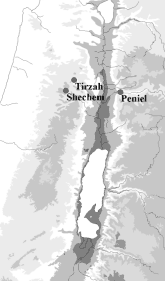
The Hebrew name is probably derives from the word for "back" or "shoulder" - an apt description of its location in the narrow valley between Mt. Gerizim and Mt. Ebal approximately 65 km North of Jerusalem (see Map 1). It was strategically located controlling major North-South and East-West roads, but lacked natural defenses and for that reason required heavy fortification. In addition to Jacob's Well (400m to the South East) it is thought that the city derived its water supply via a conduit from a cave in Mt. Gerizim (Wright, 1965: 214-228), while the fertile plain of 'Askar provided the city with food (Toombs, 1992: 1174-1175).
Map 1: Location Map of Shechem.
2 Archaeological Expeditions to Shechem
Until 1903 the exact location of Shechem had been uncertain. The Jewish writer Josephus writing about AD 90 placed the city between Mts. Gerizim and Ebal (Antiquities, 4.8.44). Later the church historian Eusebius (c. 260 - c. 340 AD) and a pilgrim from Bordeaux (333 AD) placed it on the outskirts of Neapolis (modern Nablus) near Jacob's Well. Jerome (345-420 AD) repeated Eusebius' location, but elsewhere made it clear that he doubted that Shechem was anything other than the predecessor of Neapolis. Modern scholarship followed Jerome until 1903 when a party of German scholars led by Prof. Hermann Thiersh quite by accident discovered the ruins of Shechem. Eusebius had been quite accurate: the site of Shechem, known as Tell Balatah was located East of Nablus beside the traditional site for the tomb of Joseph (Josh. 24:32) and near Jacob's Well (John 4:5-6) (Wright, 1967: 355).
Wishing to keep the excavation in German hands Thiersh did not make his discovery public and it was 1913 before the biblical scholar Ernst Sellin led the first expedition to begin excavation. Following the 1913-14 campaign the work was interrupted by the outbreak of war and it was 1928 before work recommenced, with further digs in 1932 and 1934. The results of these expeditions were often inadequately mapped and recorded and the interpretation of the finds is dubious. Although their work produced much useful data poor methodology and fieldwork as well as personal rivalry complicated later digs (Moorey, 1991: 64). In 1954 the American Drew-McCormick Expedition under George Ernest Wright started work on the site and continued in 1956-57, 1960 and 1962. The results of this work will be referred to below.
3 The History of Shechem
Shechem's strategic location and plentiful supplies of both food and water explain why it was occupied for thousands of years. The city is referred to many times both in biblical and extrabiblical records. These together with the extensive archaeological work that has been carried out enable us to trace with a fair degree of certainty the history of the city.
3.1 Before the Patriarchs. It is likely that Shechem was one of the oldest settlements in Canaan. The earliest written record comes from an inscription on the Stele of Khu-Sebek who was a noble in the court of Sesotris III (c. 1880-1840 BC). It reads: "his majesty reached a foreign country of which the name was skmm [Shechem]. Then skmm fell, together with the wretched Retunu [an Egyptian name for the inhabitants of Syro-Palestine]." An Egyptian execration text (a clay tablet on which curses are inscribed and then ceremonially broken) dating from the mid nineteenth century refers to one Ibish-hadad of Shechem, indicating that Shechem was an important centre of resistance against Egyptian rule (Toombs, 1992: 1179).
3.2 The days of the Patriarchs.
3.2.1 Abraham. The first reference to Shechem in Scripture occurs in Genesis 12:6-8. This passage records how Abram travelled southwards through Canaan until he reached the great tree of Moreh at Shechem in the centre of the land. There the Lord appeared to him and in response he build an altar and offered sacrifices to the Lord. The oak or terebinth of Moreh was to feature significantly later in the Old Testament, but it is important to note that although the location may well have been a place of Canaanite worship Abram did not associate himself with that worship (Hamilton, 1990: 377).
3.2.2 Jacob. On his return from Paddam Aram Jacob settled for a time within sight of the city of Shechem and bought the second plot of land in Canaan (33:18-20; cf. 23:1-20). There Jacob set up an altar to God, the God of Israel (El Elohe Israel). While he and his family were encamped near the city, the son of one its leading citizens, Shechem son of Hamor, took Jacob's daughter Dinah and raped her. Having found her to his liking he then persuaded his father to obtain Jacob's consent to marry Dinah. Jacob's son's tricked Hamor into disabling all the men of the city by persuading them to be circumcised themselves on the pretence of removing a ceremonial obstacle to intermarriage. Simeon and Levi pressed home the advantage they had gained by putting the city to the sword and rescued Dinah, who was apparently being held in Shechem's house (34:1-31).
Jacob was troubled by the slaughter and feared for the lives of his family when the Canaanites heard about what had taken place. Having been commanded by the Lord to move to Bethel he purified his camp of all the foreign gods and buried them under the terebinth (35:1-5). (See also COVENANT 3.2.3).
3.3 Conquest to Monarchy
3.2.1 Tribal allotment. Shechem was part of the tribal territory of Manasseh (Josh. 17:7). It was also both a city of refuge (20:7) and a Levite city, set aside for the Kohathite clan (21:20-21).
3.3.2 Covenant Renewals at Shechem. The book of Joshua records two covenant renewals carried out by Joshua (8:30-35; 24:1-27; cf. Deut. 27:11-13). Although the first does not mention Shechem by name, it is clearly implied by its location between the mountains of Gerizim and Ebal. There is no evidence either from scripture or archaeology that the Israelites conquered the city by force (Toombs, 1992; 1183-1184). This fact has served to fuel a number of the recent theories of Israel's origins (see 4 below), but does not mean that the original Canaanite inhabitants remained there during the conquest. It seems far more likely that the city was captured without a fight and that it was inhabited by Israelites. At the conclusion of the ceremony Joshua "...took a large stone and set it up there under the oak near the holy place of the Lord" (Josh. 24:26 NIV), almost certainly outside the city were both Abraham and Jacob had sacrificed (3.2.1, 3.2.2). (see COVENANT 3.3.1).
3.3.3 Joseph's Place of Burial. While he was in Egypt Joseph gave specific instructions regarding the arrangements for his burial (Gen. 50:24-26). Joseph's bones were removed from Egypt at the Exodus (Exod. 13:19) and buried in the tract of land that Jacob had bought (Josh. 24:32).
3.3.4 Abimelech & the Kingship. Following the death of Gideon Abimelech, the son of his Shechemite concubine (Judges 8:31) claimed the kingship that his father had refused (9:1-3: cf. 8:22-23). Having persuaded the citizens of Shechem to follow him he set about murdering all but one of his brothers (9:3-7). Jotham, the only surviving son of Gideon addressed the citizens of Shechem by way of a prophetic parable which foretold their destruction by fire (9:7-21). After three years the people of Shechem decided that they had had enough of Abimelech's rule and attempted to make Gaal son of Eded their leader (9:22-30). Abimelech learnt of Gaal's rebellion and attacked the city from the plain to the east as the people were going out to work in the fields (9:31-45). Once the city had fallen Abimelech turned his attention to the stronghold of the temple of Ba'al berith, where about a thousand of the city's inhabitants had taken refuge. Rather than lay siege he set fire to the tower, killing the remaining citizens of the city (9:46-49). Abimelech himself was slain shortly afterwards attempting to repeat this procedure in the nearby city of Thebez (9:50-55).
3.4 Monarch to Exile
3.4.1 David's Laments. Shechem is mentioned by David in two national laments attributed to him (Psalm 60:6-8=108:7-9). The verses cited remind the audience that it is the Lord who has measured and given the land; the people are only his tenants. He is also sovereign over the nations.
3.4.2 Jereboam's Capital. Following the death of Solomon all Israel was summoned to Shechem to make Rehoboam his son king, probably because of its historic associations. Rehoboam's foolishness resulted in the division of the kingdom with Jereboam son of Nebat ruling the ten northern tribes (2 Kings 12:1-17; 2 Chron. 10:1-17). Jeroboam initially chose Shechem as his new capital and fortified it against attacks from the South (1 Kings 12:25). The archaeological evidence for these fortifications is confused, but they appear to have taken the form of casemate walls (Toombs, 1992: 1184). The city lost much of its prestige when Jereboam moved his capital first to Peniel in the Transjordan (12:25) and then to Tirzah about seven miles to the North of Shechem (14:17) (see Map 1).
Hosea refers to the depths the Northern Kingdom had descended to in graphic language when he speaks of bands of priests who murder those on the road to Shechem (6:9). Such activity was not unknown in the days before the monarchy (cf. Judges 9:25) and was facilitated by the narrow ravines through which the city was approached (Toombs, 1992: 1175). Shechem was a city of refuge and as such was supposed to be a place of safety. Ironically the situation in the land had degenerated so far that those fleeing the avenger of blood were in danger from the very people who were meant to protect them.
3.4.3 Destruction. Archaeological evidence suggests a destruction of the city during the reign of Menahem (2 Kings 15:13-16). In 724 the city fell again to the Assyrians and was reduced to a heap of ruins along with all the other cities of the Northern Kingdom (Toombs, 1992: 1185).
3.5 After the Exile. Shechem was all but abandoned after its fall to the Assyrians. That there were still some Israelites living there is evidenced by Jeremiah's account of the ill-fated delegation from that city (41:4-7). After this time the city shows no sign of occupation for about 150 years.
3.5.1 A Samaritan City. The Assyrians settled exiled peoples from other nations in the Northern Kingdom. According to 2 Kings these peoples were taught how to worship the Lord in order to bring prevent attacks by lions, seen as divine judgement. However, the people simply added the worship of Yahweh to their own beliefs and worshipped both (2 Kings 17:24-34). During the rebuilding of the temple in Jerusalem the Samaritans sent messengers offering their help so that they might take part in the temple worship. The sharp rebuff they received led them to fiercely oppose the reconstruction and a long lasting hostility between the two peoples (Ezra 4:1-3; cf. Luke 9:52-53; John 4:9).
When Alexander the Great defeated the Persians he was initially supported by the Samaritans, who put 8 000 troops at his disposal in his campaign against Egypt. When Alexander left they attempted to free themselves from his rule:
While Alexander was in Egypt, the Samaritans in Samaria revolted and killed the newly appointed governor, Andromachus. In retaliation Alexander destroyed the city of Samaria and established a garrison of 600 troops there. Many of the Samaritans fled to the foot of Mt. Gerizim and, with Alexander's permission, built a temple to rival the Jewish temple in Jerusalem (Anderson, 1988:303-304).
In 128 BC the Jewish leader John Hyrcanus (134-104 BC) levelled the temple on Mount Gerezim, adding to the long hatred between the two peoples. In 107 BC he captured Samaria and it is thought that the final destruction of Shechem also took place at this time. The defensive walls were buried so that the could no longer be used. The surviving population relocated to the nearby towns of Sychar and Neapolis (Anderson, 1988: 304; Wright, 1965: 183-184).
3.6 Shechem in the New Testament. The city of Shechem no longer existed in the time of Jesus, but it was referred to as a historic location.
3.6.1 Stephen's Speech. Stephen's speech as recorded by Luke in Acts 7:2-53 provides a review of the history of Israel from the time of Abraham. Verse 16 and its reference to Shechem has proved particularly difficult to explain. The problem arises because it apparently contradicts the text of Genesis by stating that Abraham, rather than Jacob bought the plot of land at Shechem from the sons of Hamor (Gen. 33:18-19; cf. 23:3-20). Commentators have suggested a number of explanations for this: a) Abraham was the original purchaser of the field and Jacob merely renewed the transaction as he did with the well Abraham's servants had dug (Gen. 21:27-30; 26:28-31) (Archer, 1982: 379-380). This solution relies on an argument from silence as Genesis makes no mention of any land purchase at Shechem by Abraham. More importantly there is no reference to a tomb on the plot that Jacob bought. b) Jacob bought the site in Abraham's name, so in effect Abraham bought the land (Stott, 1990: 134). c) Luke records Stephen's speech accurately, a speech that contains a number of generalisations and conflations after the manner of popular Judaism of the period. Four similar difficulties of the same sort occur in verses 2-8 of the same chapter, indicating that Stephen was not intending to be absolutely accurate in the details he presented (Longenecker, 1981: 340-341). This seems to be the best explanation of the passage.
4 Shechem in Theological Discussion
The city of Shechem and its environs has formed an important theme in many of the reconstructions of Israel's history produced this century. The theories differ widely, but all are sceptical of the accuracy of the Old Testament account as it has come down to us.
4.1 W.O.E. Oesterley & T.H. Robinson. Oesterley & Robinson, in common with many other liberal scholars this century, saw the patriarchal narratives as describing an animistic religion. Discussing Gen. 12:6-8 they point out that 'the Oak of Moreh' should be translated 'terebinth of the teacher', which, according to them, meant that it was a tree at which divine teaching was given.
The tree was regarded as sacred. Abraham halts at it because he expects a divine manifestation there; and he is not disappointed… there is no room for doubt that we have here an instance of the development of the belief that spirits took up their abode in trees (Oesterley & Robinson, 1935: 22).
When Gen. 35:4 describes Jacob burying the 'foreign gods' and ear-rings under the Shechem terebinth, Oesterley & Robinson see this as further evidence of the worship of trees. By burying the 'gods' under the oak they were placed under the power of the tree sanctuary of Jacob's God and thus rendered harmless (Oesterley & Robinson,1935: 23). They also find evidence of animism in Gen. 35:8, where they link the name 'Oak of weeping', with the Canaanite practice of weeping for Tammuz (cf. Ezek.8:14) (Oesterley & Robinson,1935: 23-24).
On Genesis 12:6-8 it should be noted that the oak or terebinth was a spreading tree much valued for its shade. In the same way shade trees (for example the Pipal tree in Nepal and the Banyan in India) are places of meeting or markets. It is therefore not surprising that Abraham chose this place to make his camp under one, or that Jacob found one a convenient spot for burying idols and ear-rings (35:4). Further evidence for this point can be seen in the fact that in other instances God appeared to Abraham in places unconnected with trees (Harrison, 1970: 386).
4.2 Martin Noth (1902-1968). The city of Shechem plays an important role in Noth's major work The History of Israel. Noth rejected the biblical account of the conquest and argued instead that Israel's occupation of the land took place through a gradual process of infiltration (Noth, 1996: 68-74). Noth suggested that the amphictyonies of Greece and Italy provided a model for understanding the emergence of Israel in Canaan. He noticed that these cultures provided examples of groups of tribes gathered around a central shrine and united by the worship of a common deity - an organisation known as an amphictyony (Noth, 1996: 87-88). From this loose association a more structured political union could develop. The shrine near Shechem was identified as the probable location of the Israelite's first central shrine (Noth, 1996: 91-93).
Noth's proposal deeply influenced the study of Joshua and Judges for many years, but has now been largely abandoned because it demanded that the structure of Greek and Italian amphicytonies be read into the text and not out of them. In addition Noth's theory that these amphictyonies developed into political structures has also been shown to be seriously flawed (Chambers, 1983: 44-48; Gottwald, 1979: 376-386).
4.3 Norman K. Gottwald. Gottwald held that Israel emerged from within the population of Canaan and not by invasion from outside of it. Shechem was viewed as a neutral Canaanite city which worshipped Ba'al-berith and not Yahweh. (Gottwald, 1979: 563-564). Ba'al-berith was worshipped at a sacred site inside the city and Yahweh at a tree outside the city (Gen. 12:6; 33:18b-20; 35:4; Deut. 11:30; Josh. 24:26; Judges 9:6, 37). This would explain the continued existence of a temple to Ba'al-berith in Shechem (Judges 9:4) which does not require the reintroduction of a Canaanite cult (Gottwald, 1979: 564). Joshua's speech (Josh 24) is therefore seen as institution of Yahwism and not as a renewal of a pre-existing covenant. The Shechemites were among those who declined the adoption of the new faith (Gottwald, 1979: 567).
An important part of Gottwald's argument for the separation of the sites of worship is the absence of a sacred pillar inside the city of Shechem. However, archaeology has demonstrated that during the period 1450-1100 BC there was a standing stone inside the temple precinct in Shechem. Further, Gottwald ignores the reference to the temple of El-berith in Judges 9:46. It is far more likely that the name indicates the syncretistic worship that Israel had descended to (cf. Judges 8:33-35) rather than the existence of a separate Canaanite enclave (Campbell, 1983: 264-265).
© 1998 Robert I. Bradshaw
Bibliography
Anderson, R.T. 1988. "Samaritan," G.W. Bromiley, gen. ed. International Standard Bible Encyclopedia, revised, Vol. 4. Grand Rapids: Eerdmans.
Archer, Gleason L. 1982. The Encyclopedia of Biblical Difficulties. Grand Rapids: Zondervan.
Campbell, Edward F. 1983. "Judges 9 and Biblical Archaeology," Carol L. Meyers & M. O'Connor, eds. The Word of the Lord Shall Go Forth: Essays in Honor of David Noel Freedman on His Sixtieth Birthday. Winona Lake, Indiana: Eisebrauns.
Chambers, Henry E. 1983. "Ancient Amphictyonies, Sic et Non," William W. Hallo, James C. Moyer, Leo G. Perdue, Scripture in Context II: More Essays on the Comparative Method. Winona Lake, Indiana: Eisenbrauns: 39-59.
Gottwald, Norman K. 1979. The Tribes of Yahweh: A Sociology of the Religion of Liberated Israel 1250-1050 BCE. London: SCM Press.
Hamilton, Victor P. 1990. "The Book of Genesis, Chapters 1-17," The New International Commentary on the Old Testament. Grand Rapids: Eerdmans.
Harrison, R.K. 1970. Introduction To The Old Testament. London: Tyndale Press.
Longenecker, Richard N. 1981. "Acts," F.E. Gaebelein, Gen. Ed. The Expositor's Bible Commentary, Vol. 9. Grand Rapids: Zondervan.
Moorey, Roger 1991. A Century of Biblical Archaeology. Cambridge: The Lutterworth Press.
Nicholson, Ernest W. 1998. God and His People: Covenant and Theology in the Old Testament. Oxford: Clarendon Press.
Noth, Martin (1996) The History of Israel, 2nd edn. London: Xpress Reprints.
Oesterley, W.O.E. & T.H. Robinson, 1935. Hebrew Religion. London: SPCK.
Stott, J.R.W. 1990. "The Message of Acts," The Bible Speaks Today. Leicester: IVP.
Thompson, J.A. 1983. "Shechem," E.M. Blaiklock, & R.K. Harrison, eds. The New International Dictionary of Biblical Archaeology. Grand Rapids: Zondervan.
Toombs, Lawrence A. 1992. David Noel Freedman, Editor-in-Chief, Anchor Bible Dictionary, Vol. 5. London: Doubleday.
Wright, G. Ernest 1965. Shechem: The Biography of a Biblical City. London: Gerald Duckworth & Co. Ltd.
Wright, G. Ernest 1967. "Shechem," D. Winton Thomas, ed. Archaeology and Old Testament Study. Oxford: Clarendon Press: 355-370.