






Theology on the Web provides free access to thousands of theological books and articles to over 3 million visitors a year. Please consider supporting Theology on the Web so that this service can remain online
Language is a subject about which almost everyone feels qualified to speak or write about; one in which there are many practitioners, but few experts. This is because we do not consciously think about how we communicate, only what we communicate.(1) Language is a gift from God, a gift that sets us apart from the animals. It was through language that God created the world, Adam named the creatures, and the nations were scattered over the face of the earth after the flood (Gen. 11:1-9). It is also through God's Word that redemption came in Jesus, the Living Word, and to us through the Bible, God's written Word.(2) It would appear reasonable, therefore, to spend some time in attempting to grasp how we as Bible students might use language correctly in order to communicate God's Word to others.
From a historical perspective this has often not happened effectively. Preachers and popular Christian writers have been - and in many cases still are - guilty of ignoring the most basic rules of linguistics in their work of interpreting the Bible. Several reasons might be given for this:
-
In charismatic churches in particular scholarship is feared and distrusted by many pastors and most church members. In the vocabularies of the majority 'academic' and 'liberal' are synonymous.
-
Pastors face tremendous work pressures and rarely have time to keep abreast of the latest biblical research.
- Many pastors have not been to Bible College, and even those who have may find the complex linguistic terms used in text books difficult to understand.
-
Tradition dies hard - and most of the incorrect uses of word studies - especially those propagated by Vines in his Expository Dictionary of Biblical Words have passed into popular Christian tradition as established facts. Anyone challenging them would probably receive the reply: "well Pastor X said it and I believe him!"
-
The common belief that words themselves carry the meaning of what they signify, thus by analysing the word for 'sin' (for example), it is thought that one can learn more about nature of sin itself. This idea is not only based on a misunderstanding of the meaning of verbal inspiration, but also upon ignorance of exactly how language itself works.(3)
In an attempt to remedy this I am going to explain as briefly as possible the most useful insights that linguistics has given us into biblical. One caution should be mentioned at the outset: attempting to interpret the Bible using a knowledge of linguistics alone is like asking a plumber to build you a house. Although he has an essential part to play, he is only part of team. So in Biblical interpretation the other 'members of the team' - historical background, archaeology, textual criticism, etc. All of these have a part to play.
Words and Meaning
Definition: Language is a code by which the communication of thoughts takes place.
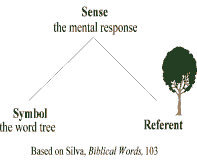 In this process words (or
idioms) serve as signs or symbols for entities, activities,
characteristics and relations.(4) It is important (as we shall
see later) to understand that words are only signs and that there is no
real reason why any particular word is given as a sign for a given object or
concept. That is why it is said that words are largely arbitrary and why words
for the same object or concept in different languages may sound completely
different, e.g. baby (English); kind (German); criatura (Spanish), and enfant (French).(5) Even onomatopoeic words (words that sound like what they refer to, e.g.
twang, smash, plop, etc.) are seldom represented by the same series of sounds.
"Thus Japanese cars go boo-boo, Hungarian roosters go kokoriku,
and French cats purr by saying ronron."(6) Because
words are arbitrary symbols one cannot study the object, person or concept
represented by a word any more than one can learn about the city of London by
an examination of a milestone directing you there. Failure to understand this
basic principle has resulted in the most common mistake made by preachers and
Bible teachers - the root fallacy.
In this process words (or
idioms) serve as signs or symbols for entities, activities,
characteristics and relations.(4) It is important (as we shall
see later) to understand that words are only signs and that there is no
real reason why any particular word is given as a sign for a given object or
concept. That is why it is said that words are largely arbitrary and why words
for the same object or concept in different languages may sound completely
different, e.g. baby (English); kind (German); criatura (Spanish), and enfant (French).(5) Even onomatopoeic words (words that sound like what they refer to, e.g.
twang, smash, plop, etc.) are seldom represented by the same series of sounds.
"Thus Japanese cars go boo-boo, Hungarian roosters go kokoriku,
and French cats purr by saying ronron."(6) Because
words are arbitrary symbols one cannot study the object, person or concept
represented by a word any more than one can learn about the city of London by
an examination of a milestone directing you there. Failure to understand this
basic principle has resulted in the most common mistake made by preachers and
Bible teachers - the root fallacy.
 The root fallacy is the mistaken
belief that a word's meaning is the sum of its components. While this is
sometimes true in the majority of cases it is not.(7) In any
case we can only know if a word is derived from the sum of its part if
we know its meaning in the first place. Consider the English word butterfly. If it is split into its component parts "butter" and "fly"
then one would conclude that a butterfly is an insect that lives exclusively on
diary products!(8) If you didn't know what a greenhouse
was, you might be surprised to learn that very few of these structures are
actually green. Likewise, what kind of nuts do you use when making doughnuts?
Such examples might seem ridiculous, so why are people fooled when the same
mistakes are repeated using Greek? The answer is that there is still a certain
mystíc about the Greek language, perhaps the result of the nineteenth
century belief that Koiné was a divine language given for the
production of the New Testament.(9) Such beliefs were
disproved with the discovery of large amounts of secular manuscripts in Koiné Greek. Nevertheless the preacher who can quote the
'original Greek' is often listened too in awe by his non-Greek
reading audience - even though he or she might be totally wrong!
The root fallacy is the mistaken
belief that a word's meaning is the sum of its components. While this is
sometimes true in the majority of cases it is not.(7) In any
case we can only know if a word is derived from the sum of its part if
we know its meaning in the first place. Consider the English word butterfly. If it is split into its component parts "butter" and "fly"
then one would conclude that a butterfly is an insect that lives exclusively on
diary products!(8) If you didn't know what a greenhouse
was, you might be surprised to learn that very few of these structures are
actually green. Likewise, what kind of nuts do you use when making doughnuts?
Such examples might seem ridiculous, so why are people fooled when the same
mistakes are repeated using Greek? The answer is that there is still a certain
mystíc about the Greek language, perhaps the result of the nineteenth
century belief that Koiné was a divine language given for the
production of the New Testament.(9) Such beliefs were
disproved with the discovery of large amounts of secular manuscripts in Koiné Greek. Nevertheless the preacher who can quote the
'original Greek' is often listened too in awe by his non-Greek
reading audience - even though he or she might be totally wrong!
 Probably the most famous example of the root fallacy is the explanation attached to the Greek word huperetes in 1 Cor. 4:1: "So then, men ought to regard us as servants or Christ and as those entrusted with the secret things of God."
(NIV). The word for "servants" is split into two parts and translated
"rower" or "under-rower". However, with only one possible exception, the word
is never used in classical Greek literature to mean a rower of any kind, and in
the New Testament it is used interchangeably with another word for a
servantdiakonos. It should therefore be translated as "servant" in this
verse.(10)
Probably the most famous example of the root fallacy is the explanation attached to the Greek word huperetes in 1 Cor. 4:1: "So then, men ought to regard us as servants or Christ and as those entrusted with the secret things of God."
(NIV). The word for "servants" is split into two parts and translated
"rower" or "under-rower". However, with only one possible exception, the word
is never used in classical Greek literature to mean a rower of any kind, and in
the New Testament it is used interchangeably with another word for a
servantdiakonos. It should therefore be translated as "servant" in this
verse.(10)
The popular movie Born Yesterday(11) provides an excellent example of the results of bad linguistics. In this scene a Washington reporter, played by William Holden [WH], is attempting to explain the meaning of an article he has written to a former chorus girl, played by Judy Hollliday [JH]:
[JH] ...You know it's interesting how many interesting things a person can learn - if they read.
[WH] I don't suppose you got a chance to read my piece?
[JH] What are you talking...? Of course I read it - twice!
[WH] What'd you think?
[JH] I think it's the best thing I ever read - I didn't understand one word.
[WH] What didn't you understand?
[JH] None of it.
[WH] Here, show me what.… Now what didn't you understand.
[JH] Well, like the name of it? "The Yellowing Democratic Manifesto."
[WH] Simple.
[JH] To who - whom - who - well anyway, not to me!
[WH] Well look, you know what yellowing means?
[JH] Not this time.
[WH] Well, when a piece of paper gets old, what happens to it.
[JH] It's thrown away?
[WH] No - it turns yellow!
[JH] It does!
[WH] Of course.
[JH] Well, what'd you know!
[WH] Now democratic - you know what that means don't you?
[JH] Not Republican.
[WH] Well, not exactly. It just means pertaining to our form of government which is a democracy.
[JH] What's pertaining?
[WH] ...has to do with.
[JH] Pertaining - nice word!
[WH] Alright - "Manifesto."
[JH] I don't know.
[WH] Why didn't you look it up?
[JH] I did look it up - I still don't know!
[WH] Well look, when I say "manifesto" I mean a set of rules and principles and ideals and hopes on which the United States is based; the ideas of those men who wrote that Constitution up there.
[JH ]And you think it's turning yellow?
[WH] Yes, I think a lot of the original inspiration has been neglected and forgotten.
[JH] And that's bad?
[WH] And that's bad.
[JH] [Continuing to read.] "Even a cursory?"
[WH] "Cursory"
[JH] "...examination of contemporary… society in terms of the Greek… philosophy which defines the whole as a representation of its parts send one immediately to a consideration of the individual as a citizen and a citizen as an individual."
[WH] Well.
[JH] I looked up every word!
[WH] Listen. Thousands of years ago a Greek philosopher said that the world could only be as good as the people who lived in it.
[JH] Makes sense.
[WH] So I said, you take one look at America today and right away you figure that you'd better take a look at the people who live in it, one by one, sorta.
[JH] That's this?
[WH] Sure.
[JH] Well why didn't you say so?
You might think that this example is rather amusing, but this is exactly what many people do when read the Bible, especially when learning to translate the Greek New Testament. One of the mistakes Judy Holliday's character made was to think that the meaning of a sentence is equal to the sum of the words in it, such as:
"The" + "Yellowing" + "Democratic" + "Manifesto" = the meaning of the sentence
In fact this didn't give the meaning of the sentence, as she stated later on in the excerpt, because the meaning of a sentence is not the sum of the meanings of the words in it.(12) It could almost be said that considered apart from their context words have no meaning; they receive a meaning only when a sentence, paragraph, chapter or even the entire book or letter is considered as a whole.
Besides being arbitrary symbols, words are also polysemous; that is they do not represent just one object, person or concept, but many. Consider the following examples that all use the word 'flag':
After 24 miles the marathon runner was beginning to flag.
Everyone stood to attention as the flag was raised.
The old lady broke her leg when she tripped on the lose flag.
The Queen's visit to Australia was simply to fly the flag.
John was on the road for hours before he managed to flag-down as passing motorist.
Now imagine that you were to read all these possible meanings of 'flag' into the last sentence. You could then understand it as meaning:
John was on the road for hours and was extremely tired. Eventually he was able to hit a passing motorist with a piece of concrete coloured red, white and blue. In doing so he succeeded in making a political statement about sovereignty.
Does that sound silly? Well what you have just read is an example of a second word-study fallacy, known as illegitimate totality transfer. That means the unjustified inclusion of all the possible meanings of a word regardless of the limitations of the context.(13) The Amplified Bible is particularly guilty of committing this fallacy. For example in Galatians 3:8 it translates "gospel" as "the good news about Jesus Christ" thus implying (according to one teacher I have heard) that Abraham knew everything about Jesus Christ and His work. In this context the 'good news' being announced in advance was the possibility of justification apart from obedience to the Law of Moses and specifically that "all nations will be blessed through you." When attempting to determine the meaning certain biblical terms, such as sin, righteousness and propitiation appeal is often made to the words non-biblical usage. This can be extremely useful, but the danger of committing illegitimate totality transfer is great.
In all lexical study, it is imperative that the meaning in the present context be given precedence over all other considerations. The fact that a word may be used 99 percent of the time it is found in ancient writings to mean one thing is essentially irrelevant if the context of the biblical passage under study it is used to mean something else. Any author may choose to use even a common word in an unusual way. Thus the final question must always be "How is it used here?" rather than "How does its use elsewhere tell us what it means here?" The latter question is not always entirely useless; it is, however, always a secondary question in lexical analysis to the question of meaning in the immediate context.(14)
A good example of this is the tremendous amount of effort has been wasted on arguing whether kephale means "head" or "source" according to its usage in extra-biblical writings rather than its use 1 Cor 11:2b and Eph 5:23-24.(15) The context of a word is the determining factor in deciding which one of the many possible meanings the word has is to be used. This context includes not only the function of the word within a sentence or paragraph, but also the historical and cultural context of the writer and original audience. Many mistakes have been made by neglecting the wider context, especially when translating the Bible into another language.(16)
The opposite of illegitimate totality transfer is the one meaning fallacy, which states that a word always has the same meaning regardless of the context it is used in. It too ignores the fact that words are polysemous. The origins of this fallacy are in the false assumption that words from one language have exact equivalents in another(17) and is reinforced by use of lexicons, such as those contained in Strong's Concordance. One particularly bad example of this is provided by Kenneth Hagin, Snr:
The natural man is the man motivated by the flesh; a physical man, not a spiritual man. (I found out years ago it helped me in my studies of Romans, every place it says 'flesh' to substitute the word "senses" or "physical senses" .After all, the only way the flesh has any expression is through its physical senses. It will clear up a lot of thinking for you if you will do this.)(18)
The only problem with Hagin's simplification is that it is simply not true. Sarx which is translated 'flesh' in the KJV, does not only mean 'senses' or 'physical senses'. F.F. Bruce gives a more accurate assessment of the variety of meanings for sarx in Romans:
1) The physical body (Rom. 2:28).
2) Natural human descent or relationship (Rom. 1:3; 9:3, 5; 11:14). This physical descent from Abraham is contrasted with spiritual descent (4:1, 11-12, 16).
3) Mankind as a whole (3:20; cf. Mark 13:20 - "no one" NIV).
4) Human Nature:
i) Weak human nature (Rom. 6:19; 8:3; cf. Matt. 26:41).
ii) The human nature of Christ (Rom. 8:3 "likeness of sinful man" NIV).
iii) The 'old sin nature' in the believer (Rom. 7:18; Gal. 5:24; Eph. 4:22, 24; Col. 3:9-10).
iv) Unregenerate human nature (Rom. 7:5; 8:8-9).
5) In contrast with the new life in the Spirit (Rom. 8:4-5, 12-13).
6) Sin in general as a work of the sinful nature (Rom. 8:13; Gal. 5:19-21; 6:8).(19)
From this it is clear that the meaning of sarx cannot be determined apart from in a context. Some would even go so far as to say that it has no meaning apart from in a context, only a possibility of meaning.(20)
The meanings of words are not static; language changes and develops as the people who use it change and develop. Over the centuries the range of meanings a word has (its semantic range) changes, a process known as diachronic change. The word martus has gone through he following development:
a) one who gives evidence in or out of court
b) one who gives solemn witness or affirmation (e.g. of one's faith)
c) one who witnesses to personal faith, even in the threat of death
d) one who witnesses to personal faith by acceptance of death
e) one who dies for a cause - a "martyr"(21)
 Diachronic change is a further reason why evidence from
classical sources and the Septuagint (the Greek translation of the Old
Testament, started about 250 BC) must be treated with caution. Many of the
words used had changed their meanings by New Testament times. Related to this
is the mistake of reading a later meaning back into a biblical word, known as semantic anachronism. The most famous being the likening of the power of
the Holy Spirit to dynamite on the grounds that the name 'dynamite'
was derived from the Greek worddunamis. This is anachronistic because
dynamite was not invented until 1867 when Alfred Bernhard Nobel (1833-96)
succeeded in mixing nitro-glycerine with an organic packing material. Nobel
named it dynamite because dunamij means 'power' .There were no explosives
in the ancient world, and it was not until the 13th century that gunpowder
became widely available, so it would be impossible for Paul or any New
Testament writer to have been thinking of dynamite. This is not he only problem
with this particular word study:
Diachronic change is a further reason why evidence from
classical sources and the Septuagint (the Greek translation of the Old
Testament, started about 250 BC) must be treated with caution. Many of the
words used had changed their meanings by New Testament times. Related to this
is the mistake of reading a later meaning back into a biblical word, known as semantic anachronism. The most famous being the likening of the power of
the Holy Spirit to dynamite on the grounds that the name 'dynamite'
was derived from the Greek worddunamis. This is anachronistic because
dynamite was not invented until 1867 when Alfred Bernhard Nobel (1833-96)
succeeded in mixing nitro-glycerine with an organic packing material. Nobel
named it dynamite because dunamij means 'power' .There were no explosives
in the ancient world, and it was not until the 13th century that gunpowder
became widely available, so it would be impossible for Paul or any New
Testament writer to have been thinking of dynamite. This is not he only problem
with this particular word study:
Dynamite blows things up, tears things down, rips out rock, gouges holes, destroys things. The power of God concerning which Paul speaks he often identifies with the power that raised Jesus from the dead (e.g. Eph. 1:18-20); and as it operates in us, its goal is… ("unto salvation," Rom. 1:16 KJV), aiming for the wholeness and perfection implicit in the consummation of our salvation. Quite apart from the semantic anachronism, therefore, dynamite appears inadequate as a means of raising Jesus from the dead or as a means of conforming us to the likeness of Christ. Of course, what preachers are trying to do is to do when they talk about dynamite is to give some indication of the power involved. Even so, Paul's' measure is not dynamite, but the empty tomb.(22)
No one sniggers when someone is called a "nice" person because the fact that it comes from the Latin nescius (ignorant) is no longer relevant.(23) "In exactly the same way, it is sheer semantic anachronism to note that in the text "God loves a cheerful giver" (2 Cor 9:2) the Greek word behind "cheerful" is hilaron and conclude that what God really loves is a hilarious giver."(24) The point is that you should not try to discover a word's meaning by studying its history.(25) A words history is only relevant if it can be clearly demonstrated that the writer was aware of its original meaning.(26) This does not mean that diachronic word study is totally useless because it is helpful to know how a word's meaning has changed over time.(27) It is the meaning at the time of writing (the synchronic meaning) that is most important for the correct exegesis of a passage.
As they develop some words take on a technical meaning and its semantic range becomes narrower. One positive example of this is the use of naos) for "temple" in 1 Cor. 3:16 "refers to the actual sanctuary, the place of the deities dwelling, in contrast to the word hieron, which referred to the temple precincts as well as to the sanctuary."(28) Paul is saying that the Church is the Holy of Holies where the very presence of God dwells. False assumptions about technical meaning are also common. Roger Forster and Paul Marston - who are guilty of producing some of the worse word-studies in print - argue that the Hebrew word eretz and Greek ge (2 Peter 2:5-7) cannot mean "the whole globe" when describing the extent of Noah's flood.(29) However, the context of Genesis 7:17-24 demands that the flood be universal and cover the whole of the globe.(30) Only Forster & Marston's determination to prove that the flood was a local event prevents them from seeing this.
Those who believe that a Christians can be possessed by a demon often appeal to the supposed technical usage of the phrase "a Daughter of Abraham" in Luke 13:10-17 and "Children of Abraham" in John 8:31-47. They claim that this phrase is only used of believers. Paul does use the phrase "Children of Abraham" in a distinctive and technical sense, referring to Believers (Romans 4:16-17; Gal. 3:6-7). Other New Testament writers use it in a non-technical sense, referring to the physical descendants of Abraham (e.g. Luke 19:9; Acts 13:26). Only by importing the Pauline usage into the Gospels can a case be made that Jesus only delivered Believers.(31) It is interesting to note that if he were consistent in doing this then the Rich man in the story of Lazarus must also have been a Believer (see Luke 16:24,30). Another example is to be found in John 8:31-47 because John refers to the crowd as those 'who had believed' in Jesus (v.31). This crowd then refer to themselves as 'Abraham's children' (v.39). But, as Carson points out, "those who believed in him", refers to those of 'fickle faith' (cf. John 6:60-69) who do not abide in Jesus (John 15).(32) In these passages therefore 'Children of Abraham' does not refer to Christian Believers, but to Jews.
Ambiguity and Vagueness
As we saw above the possible range of meanings a word can have is normally reduced to one by the context in which it occurs. When more than one meaning is possible then we say that the meaning is ambiguous. In normal speech and writing ambiguity is something which most people try to avoid because they want to make their meaning clear, but a certain degree of vagueness is usual. We hardly ever give the list of all the flowers visible out of a window; rather we would speak generally and comment: "Isn't the garden looking nice!" It is therefore misleading to demand from the biblical writers an exactness that we would not expect from anyone else.(33) There are times when ambiguity is useful, for example, when attempting to avoid giving a straight answer to a question. Some biblical texts are ambiguous because we do not understand the language completely, the meanings of some words in certain contexts being very difficult to establish (e.g. 1 Cor. 2:13). It may be that on occasions the writer actually wished his readers to understand more than one meaning from a word. There are several examples of ambiguity in the New Testament, katalambano in John 1:5 could be translated either as 'overcome' or 'understood'. Either would fit the context and it is probable that John intended the reader to understand both meanings.(34)
There is one more element from linguistics that is particularly useful in studying the Bible. In certain contexts some words can be used interchangeable, in which case they are known as synonyms. Very few words are complete synonyms which are interchangeable in every context, because in normal language development one or other would soon fall out of use. Those that do exist are usually technical terms. A writer or speaker makes use of synonyms for stylistic reasons and to avoid repeating the same word again and again and again. Very often failure to recognise when terms are being used synonymously leads to a misunderstanding of a biblical text, and even in some cases to the establishment of a false doctrine. Consider the example of 1 Thess. 5:23: "May God himself, the God of peace, sanctify you through and through. May your whole spirit, soul and body be kept blameless at the coming of our Lord Jesus Christ." This verse (it is claimed) teaches that human beings are made up of three distinct parts: body, soul and spirit. However, it is unwise to attempt to establish such a doctrine on this verse because all three words are being used synonymously to emphasise the completeness of the sanctification, not the supposed divisibility of man.(35) Another example is the alleged difference between a rhema word and a logos word. A 'logos' is a verse from the Bible, while a rhema word is a personal message for you, applicable to your life. Through a process of revelation it is said that the 'logos' becomes a 'rhema' when you realise its relevance to your life. Although there is a truth underlying this, the word study on which it is based is flawed, because the words rhema and logos are used interchangeably in the New Testament for stylistic reasons.(36) On the positive side by understanding why a particular word was chosen as opposed to the other synonyms available can be helpful, because sometimes the choice is significant.
Now that we have covered the basics of linguistics and the main
pitfalls to avoid I want to look at a word study that involves combination of a
number of different errors.
Example 1
One of the most popular word studies found in present day preaching concerns the words used in the Bible for 'love' .Generally four words are cited, but only two, agapao and phileo will be covered here, as most studies centre on them. The normal line of argument is as follows: Agape is almost absent from Classical Greek literature, and while the meaning of phileo became debased by sin, the biblical writers found in agape a 'neutral' word into which the richness and the depth of God's love expressed through Christ could be poured. Therefore in the Bible agapao and phileo are never used interchangeably because both the New Testament writers and their audience recognised the distinction between the meanings of the two words, and this accounts for the rapid rise to prominence of agapao.(37) Or, as one book puts it::
...in the case of the noun agape there is no corresponding negative usage in the NT. It is always used in the sense of… the love of God… or referring to the divine love for other men which the presence of God evokes… (38)
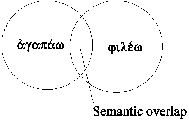
Most modern books on hermeneutics have severely criticised the validity of these claims, pointing out that agapao and phileo (while sometimes having distinct meanings) are often used interchangeably in the New Testament. Figure 1 below shows graphically the relationship between the two words.
Figure 1: The Semantic Relationships of Two Greek Words For "Love"
When looking at the meaning of words it is important to know how and why their meaning has changed over time (diachronic change), especially when so much weight is put on their meanings in the course of a sermon. It has now been established that from the fourth century on agapao became more common in Greek literature because of a change of usage concerning the word phileo:(39)
...[phileo] had acquired this new and additional meaning because an older verb for 'to kiss,' kunšw, was dropping out; and the reason for this latter disappearance was the homonymic clash with yet another verb, [kuno] (which means to impregnate), particularly in the aorist both kunew (to kiss) and [kuno] (to impregnate) have the same form [ekusa]. This would encourage various salacious puns and gradually force [kuneo] into obsolescence.(40)
An example of the same process is occurring in the English language today. The word 'gay' means "light-hearted, carefree, sportive; airy, offhand,"(41) but over the last few decades it has acquired a new and pejorative meaning - "to be a homosexual" .The result is that the former meanings of 'gay' will no longer be used in English, and another word (e.g. happy) will take over its part in the language. This is what happened in Koiné Greek with phileo, agapao and kuneo.
Biblical examples of the uses of agapao & phileo are not hard to find. Both words are used of Jacob's preferential love for Joseph in the Septuagint (or LXX) of Gen. 37:3, 4.(42) When Amnon rapes his sister Tamar, both are used to refer to his 'love' (1 Sam 13). While there is only one verb for 'love' in the Hebrew text of Proverbs 8:17, the LXX uses both agapao and phileo."(43)
Perhaps the most famous example (or infamous, depending upon how you look at it) is the use the Apostle John makes of the two verbs in John 21:15-17. Many sermons have been based on the change in the words John uses in this passage (see Table 1) most scholars agree that
...the narrator's interest is in the repetition of the same thought, not in subtle differences in meaning of particular words. Peter is saddened (v.17) by the persistent repeating of a question he has already answered, but the purpose of the repetition is to match his earlier triple denial and to elicit from him a firm commitment to continue the Shepherd's work during the time of the Shepherd's absence.(44)
Table 1: Love in John 21:15-17
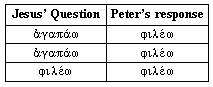
From Carson, Fallacies, 52.
Within the same passage John also used synonyms for 'tend' and 'sheep', a fact that adds weight to the contention that the difference here is simply stylistic.(45) The argument is clinched by the following observation:
When we read that Demas forsook Paul because he loved the present evil world, there is no linguistic reason to be surprised that the verb is [agapao](2 Tim. 4:10). John 3:35 records that the Father loves the Son and uses the verb [agapao]; John 5:20 repeats the thought, but uses filšw without any discernible shift in meaning.(46)
These words studies have passed into Christian tradition, and like
all tradition have acquired a certain infallibility. However, there is nothing
inherently special about either the verb agapao or the noun agape. Agapao is often used interchangeably with filšw, and
any doctrine based on some apparent distinction is fatally flawed. It is true
that God's love is special, but there is no unique word to describe it in
Greek, any more than there is in English.
Example 2
Christians often play with words. How many of us have heard of or used the following ploy in witnessing?
John: I don't want to become a Christian because I hate religion.
Christian X: Well I'm a Christian and I hate religion too!
John: [confused]. What do you mean? Christianity is a religion isn't it?
Christian X: No it isn't .A religion is man's attempt to find God. Christianity is God reaching out and finding man. So it's not a religion!
 "John" may be convinced by this
argument, as many people have been in the past, but "the ends justifies the
means" is not a Christian principle. What we have here is an example of the Humpty-Dumpty effect, named after a famous speech by the fore-mentioned
character in Alice Through The Looking Glass. Humpty Dumpty declared
that "When I use a word, it means what I want it to mean, nothing more, nothing
less." Alice told him that he was wrong, and she was right to do so, because no
one can play fast and loose with words and get away with it. A series of words
cannot mean anything you wish them to mean.
"John" may be convinced by this
argument, as many people have been in the past, but "the ends justifies the
means" is not a Christian principle. What we have here is an example of the Humpty-Dumpty effect, named after a famous speech by the fore-mentioned
character in Alice Through The Looking Glass. Humpty Dumpty declared
that "When I use a word, it means what I want it to mean, nothing more, nothing
less." Alice told him that he was wrong, and she was right to do so, because no
one can play fast and loose with words and get away with it. A series of words
cannot mean anything you wish them to mean.
Returning to our example we have to agree with John that Christianity is a religion. The Concise Oxford Dictionary defines a religion as a "particular system of faith and worship" and then cites Christianity as an example. Christianity is called a religion in 1 Tim. 5:4 & James 1:26-27.
A more truthful way of answering John's objection would have been to explain that while Christianity is a religion it differs from other religions in that it is the only religion that God Himself accepts (John 14:6; Acts 4:12). We could also be careful to avoid our own technical "in-house" language which often excludes and confuses non-Christians: Are you washed in the blood? In the blessing. True to the faith. Filled with the Spirit. Living in Victory. The Holy Ghost, etc.
Conclusion
Finally, there is one caution that cannot emphasised enough in these days when sound doctrine is no longer well received.
The value of studying biblical languages does not reside in its potential for displaying exegetical razzle-dazzle. In fact, striking interpretations that lean too heavily, sometimes exclusively, on subtle grammatical distinctions are seldom worth considering… More often than not, the fruit of language learning is intangible: it remains in the background, providing the right perspective for responsible exegesis.(47)
Atomistic examinations of words often leads to a neglecting of the importance of the context from which the words derive their meanings.(48) Our main effort should be concentrated on learning more about the concepts that the words signify rather than concentrating on the words themselves. Someone studying the concept of "hypocrisy" with a concordance would miss an importance passage (Isa. 1:10-15) simply because it does not contain the relevant word even though it does add to our understanding of the concept.(49)
This does not mean that all word studies are wrong or pointless, rather it means that we need to be more careful in carrying them out and put more emphasis on the context in which the words occur.
© 1997 Robert I. Bradshaw
References
(1) Moisés Silva, God, Language and Scripture. Reading the Bible in the Light of Contemporary Linguistics. Foundations of Contemporary Interpretation, Vol. 4. (Leicester: Apollos, 1990), 15.
(2) Silva, Language, 19-40.
(3) Elliott E. Johnson, Expository Hermeneutics: An Introduction. (Grand Rapids: Zondervan, 1990), 10; Anthony C. Thiselton, "Semantics and New Testament Interpretation," I.H. Marshall, ed. New Testament Interpretation (Exeter: Paternoster Press, 1977), 78.
(4) Eugene A Nida & Johannes P. Louw, Lexical Semantics of the Greek New Testament (Atlanta: Georgia: Scholars Press, 1992), 4.
(5) David Alan Black, Linguistics For Students of New Testament Greek. A Survey of Basic Concepts and Applications . (Grand Rapids: Baker, 1988), 15-16.
(6)Black, 16.
(7) J.P. Louw, Semantics of New Testament Greek (Atlanta, Georgia: Scholars Press, 1982), 28.
(8) Louw, 29.
(9) Moisés Silva, Biblical Words & Their Meaning: An Introduction to Lexical Semantics (Grand Rapids: Zondervan, 1983), 23-24, 65.
(10) Louw, 26-27; D.A. Carson, Exegetical Fallacies, 1984 (Grand Rapids: Baker Book House, 1989), 27-28.
(11) George Cukor, Director, Born Yesterday, 1950.
(12) R.H. Robins, General Linguistics: An Introductory Survey. (London, 1964), 22. Cited by Thiselton, 85.
(13) Silva, Biblical Words, 25.
(14) Douglas Stuart, "Exegesis," David Noel Freedman (ed. in chief), The Anchor Bible Dictionary, Vol. 2 (New York: Doubleday, 1992), 686.
(15) Osborne, 66.
(16) Louw, 14-15.
(17) Louw, 48.
(18) Kenneth E. Hagin, Growing Up Spiritually (Tulsa: Faith Library Publications, 1982), 107.
(19) Based upon F.F. Bruce, "The Letter of Paul to the Romans," Tyndale New Testament Commentary, 1985 (Grand Rapids: Eerdmans, 1988), 40-44.
(20) Louw, 39-40.
(21) Carson, Fallacies, 35. Even a recent Church England Report makes this mistake when it notes that: "We need to remember that 'martyrdom' literally means 'witness'..." The Doctrine Commission of the Church of England,The Mystery of Salvation: The Story of God's Gift. (London: Church House Publishing, 1995), 127-128.
(22) Carson, Fallacies, 33.
(23) Silva, Biblical, 38.
(24) Carson, Fallacies, 33.
(25) Thiselton, 80-81: "When Englishmen say "Good-bye" do they "properly" mean "God with you" ?"Hussy" is etymologically a doublet of "housewife", but can it be said on this basis that if I were to call someone a hussy I "properly" meant only "housewife"?
(26) Silva, Biblical Words, 48.
(27) Thiselton, 82.
(28) Gordon D. Fee, "The First Epistle to the Corinthians," NICNT, 1987 (Grand Rapids: Eerdmans Publishing Co., 1989), 146.
(29) Roger Forster & Paul Marston, Reason & Faith: Do modern science and Christian Faith really conflict? (Eastbourne: Monarch Publications, 1989), 235-239.
(30) H.C. Leopold, Exposition of Genesis, 1942, Vol. 1. (Grand Rapids: Baker Book House, 1971), 301-302: "[In Genesis 7:] 19. A Measure of the waters is now made by comparison with the only available standard for such waters - the mountains. They are said to have been "covered" .Not a few merely, but "all the high mountains under all the heavens." One of these expressions alone would almost necessitate that the author intends to convey the idea of the absolute universality of the Flood, e.g. "all the high mountains." Yet since "all" is known to be used is a relative sense, the writer removes all possible ambiguity by adding the phrase "under all the heavens." A double "all" (kol) cannot allow for so relative a sense. It almost constitutes a Hebrew superlative. So we believe that the text disposes of the question of the universality of the Flood.
By way of objection to this interpretation those who believe in a limited flood, which extended perhaps as far as mankind may have penetrated at that time, urge the fact that kol is used in a relative sense, as is clearly the case in passages such as [Gen.] 41:57; Exod. 9:25; 10:15; Deut, 2:25; 1 Kings 10 :24. However, we still insist that this fact could overthrow a single kol, never a double kol, as our verse has it.
(31) See further: Carson, Fallacies, 45-48.
(32) D.A. Carson, The Gospel According To John (Leicester: IVP, 1991), 347-348.
(33) Thiselton, 94: "Too often in biblical interpretation exegetes have looked for exactness where the author chose vagueness. Must the "horrifying abomination" in Mark 13:14 refer specifically to the violence of the zealots, or to a statue of Titus, or to Caligula or Hadrian? Must "Son of man" be robbed of an ambiguity which may have commended the term to Jesus? Might not the New Testament writers have wished to keep some ideas open-ended no less often than we do?"
(34) Louw, 41: "Overwhelm" renders a feeling of joy - the darkness did not overwhelm the light; "understand" renders plaintive tone - the darkness did not understand the light. Such a play on words often occurs in John. It is characteristic of his style."
(35) Leon Morris, "1 and 2 Thessalonians," rev., 1984. Tyndale New Testament Commentaries. (Downers Grove, Ill.: IVP, 1989): 111: "This is sometimes used as an argument for a trichotomous view of man… as against a dichotomous view, but this is probably unjustified (cf. Mark 12:30 for a fourfold division and 1 Cor. 7:34 for a twofold one). Paul is not analysing the nature of man, but uttering a fervent prayer that the entire man be preserved.… That the unity of man is being emphasized is indicated by the fact that both the verb and the adjective whole are singular, though they apply to all three."
(36) Johannes P. Louw & Eugene A Nida, eds. Greek-English Lexicon of the New Testament Based on Semantic Domains, 2nd edn., Vol. 1 (New York: United Bible Societies, 1989), 400.
(37) Wuest, Kenneth S. Word Studies in the Greek New Testament, Vol. 3 (Plainfield, N.J.: Logos Int., n.d.) 113-114.
(38) Günther, W. & Link, H.-G. "Love," Colin Brown, ed. NIDNTT, Vol. 2. (Grand Rapids: Zondervan, 1986), 543.
(39) D.A. Carson, Exegetical Fallacies. (Grand Rapids: Baker, 1984), 52-53.
(40) Carson, Fallacies, 53, n. 62. Square brackets contain transliterations of Greek characters.
(41) J.B. Sykes, ed. The Oxford Concise Dictionary, 6th edn. (Oxford: Clarendon Press, 1976), 440.
(42) D.A. Carson, The Gospel According To John. (Leicester: IVP/Eerdmans, 1991), 676.
(43) Carson, John, 276.
(44) Michaels, J. Ramsey, "John," NIBC. (Peabody: Hendrickson, 1989), 360.
(45) Grant R. Osborne, The Hermeneutical Spiral. (Downers Grove: IVP, 1991), 88. Carson, John, 677: "In addition to the two words for 'love', John resorts to three other pairs: bosko and poimaino ('feed' and 'take care of' the sheep), arnia and probata ('lambs' and 'sheep'), and oida and ginosko (both rendered 'you know' in v.17). These have not stirred homiletic imaginations; it is difficult to see why the first pair should."
(46) Carson, Fallacies, 30. Square brackets contain tranliterations of Greek characters in original.
(47) Moisés Silva, Has The Church Misread The Bible? (Leicester: Apollos, 1987), 13. Emphasis mine.
(48) Silva, Biblical Words, 138-139.
(49) Silva, Biblical Words, 27, 28: "The point is that we learn much more about the doctrine of sin by John's statement, "Sin is the transgression of the law," than by a word-study of [harmartia]; similarly, tracing the history of the word [hagios] is relatively unimportant for the doctrine of sanctification once we have examined Romans 6-8 and related passages." Squared brackets Greek characters in original.