






Theology on the Web provides free access to thousands of theological books and articles to over 3 million visitors a year. Please consider supporting Theology on the Web so that this service can remain online
1 Life and Ministry
The reign of Ahab was a dark hour for Israel. Not only had he and his father Omri exceeded the sins of all the kings that preceded them in their worship of Jehoboam's golden calves, but he had also married Jezebel, daughter of Ethbaal the priest-king of the Sidonians (878-866 BC) (1 Kings 16:25-26). This marriage, contracted during the reign of Omri, was political in nature and intended to cement an alliance between the two nations. It was expected that in such alliances provision be made for the bride to be able to practice her own religion in her new home (cf. Solomon's wives 1 Kings 11:1-8). Jezebel went one step further as priestess of Ba'al Melqart, the chief deity of TYRE. She reintroduced the worship of the Canaanite deities Ba'al and Asherah to the Northern Kingdom. To that end she personally supported 450 prophets of Ba'al and 400 prophets of Asherah (1 Kings 18:19), which meant that they were funded from the royal treasury. F.F. Bruce notes:
Ahab, while he patronized the new cult, appears to have been a Yahweh-worshipper, to judge by the names borne by the children who names we know - Jehoram ("Yahweh is high"), Ahaziah ("Yahweh has taken hold"), Athaliah ("Yahweh is exalted"). (Bruce, 1987: 44).
The situation was not acceptable to the prophets of Yahweh and it is noteworthy that in the hour of Israel's greatest danger one of the greatest of the Old Testament prophets was raised up to counter it.
1.1 Elijah's Challenge to Ba'al. In a similar way to the writers of Kings treatment of other prophets who rebuked and guided the king of Israel and Judah (see Table 1), Elijah's entry into the biblical account is abrupt and dramatic. His name "Yah is God" pronounced a challenge before he announces his message. The writer identifies him as "the Tishbite, from Tishbe in Gilead", but his origin is uncertain. Traditionally the town of Listib, located 8 miles North of the Jabbok River has been identified with Tishbe. However, it is now thought more likely that Tishbe was located in Naphtali (Thisbe in Tobit 1:2), because Listib is known to have been uninhabited during the time of the northern kingdom (Harrison, 1982: 861). The verse should therefore be translated "one of the settlers in Gilead" (see NIV footnote), a wild and rugged region in the Transjordan (see Map).
Map: Significant Locations in the Life of Elijah
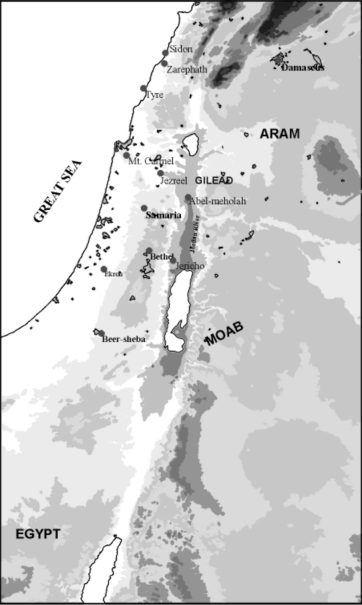
Elijah challenged the power of Ba'al (see 3) and acted as Yahweh's agent in reminding Ahab of the consequences of breaking the terms of the Covenant (Deut. 11:16-17; 28:23-24; Lev. 28:19; 1 Kings 8:35). Just as suddenly as he appeared, Elijah departs denying Ahab the opportunity to bribe or threaten him into changing his curse into a blessing (cf. 1 Kings 13: 7-10). So, evading any pursuit, he traveled to the Kirith Ravine, East of the Jordan where he is miraculously fed by Ravens (17:4-7). This provision reminds the reader of Yahweh's feeding of the children of Israel in the wilderness (Exod. 16:12-13). After some time the drought begins to take effect and the stream that had sustained him dries up. Rather than provide water for him (cf. Exod. 17:1-7) the Lord commanded him to leave for a town located in the heartland of Ba'al worship, Zarephath in the region of Sidon (1 Kings 17:7-8) which was presumably the last place that Ahab would think of looking for him (18:10) (see Map). The NIV translation "I have commanded" sounds somewhat strange, as the widow herself shows no knowledge of any such command - "I have ordained" is perhaps more accurate (Provan, 1995: 135). When he arrived Elijah followed the instruction he had been given and persuaded a widow there to feed him (cf. Luke 4:25-26). Although she had only enough for one last meal Elijah asked her to feed him first. Taking what little she had Elijah promised that her supply of flour and oil would be miraculously replenished until the drought was over (17:13-14; cf. 2 kings 4:1-6; Matt. 14:16-20; Mark 6:37-43; Luke 9:13-17; John 6:5-13). The faith of the widow is tested again when her son dies (17:17-18). When Elijah gives him back to her alive and she is finally convinced that he is a true servant of the living God (17:24).
After three years Elijah is commanded to meet with Ahab once again. It is at this point that the writer of Kings introduces a new character, Obadiah, the Royal chamberlain. While Elijah had been hiding in the home country of Jezebel, this man had been serving the Lord within the very household of the King, and unknown to Elijah (18:13-14; cf. 18:22; 19:10, 14), had secretly preserved the lives of 100 of the Lord's prophets (18:2b-4). Obadiah was searching for pastures for the kings mules and horses when Elijah met him and told him to tell Ahab where he could be found (18:8). The time had come for a showdown and so Elijah summoned 450 prophets of Ba'al and 400 prophets of Asherah to appear together with the people of Israel on Mount Carmel. He made it clear that even if Ahab was prepared to worship both Yahweh and Ba'al the time had now come for the people to choose one way or the other (18:20-21; cf. Josh. 24:15).
The test Elijah proposed was not without historical precedent (Lev. 9:23-24): the God who answered by fire was the true God (1 Kings 18:23-24). The prophets of Ba'al went first, building an altar and sacrificing two bulls on it. They danced around their altar until noon without result and it was at that point that Elijah started to taunt them (18:27), driving them into an even greater frenzy (18:29), but there was no answer from Ba'al. Finally, at the time of the evening sacrifice, that is, at twilight (Exod. 29:38-41; Num. 28:3-8) it was Elijah's turn. He rebuilt the old altar on the high place using twelve field stones (cf. Exod. 24:4; Josh. 4:2-9, 20). The reader is reminded by this (and the reference to the evening sacrifice taking place in Jerusalem at the same time) that Israel still consists of twelve tribes despite the present division of the nation (18:31). Elijah went further. He had a trench dug around the altar and had the sacrifice soaked in water twelve times ("four jars, emptied three times each..." Provan, 1995: 142), to rule out any suggestion of cheating on his part. Then, praying a simply prayer, he calls on the Lord to answer. The Lord does answer: fire consumes not only the meat, but the entire altar (cf. Lev. 9:24; 1 Chron. 21:26; 2 Chron. 7:1) and the people finally respond to Elijah's challenge (1 Kings 18:32-39). The prophets of Ba'al were taken down into the Kishon Valley and executed - probably by being hewn to pieces with swords (18:40; 19:1; cf. Deut. 13:13-18; 17:2-5; Josh. 7:24-25). Having convinced the people of the supremacy of Yahweh, Elijah sent the King away and went with only a servant to pray on the mountain top. Again the Lord answered his prayer and torrential rain was soon on the way. Running ahead of Ahab's chariot in the place of a servant (2 Sam. 15:1; 1 Kings 1:5) Elijah led the way to Ahab's summer residence at Jezreel (Keil, 1988: 251-252).
1.2 Elijah's Recommissioning. Ahab and the prophets of Ba'al were dealt with, but what of Jezebel and the prophets of Asherah who had not presented themselves at Mt. Carmel? The answer is not long in coming. When Jezebel learns of what has transpired on the mountain (events that Ahab attributes to the work of Elijah alone) she immediately sends a messenger to Elijah, threatening him with death in the name of her gods (19:2). Elijah's reaction is in sharp contrast to his earlier acts of faith and obedience to the Lord and his boldness in the face of opposition. He flees southwards in an effort to put as much distance between himself and Jezebel as possible. Leaving his servant at Beersheba in the South of Judah (see Map) he went a day's journey further into the desert, lay down under a broom tree and prayed that he might die (19:2-4). The Lord's response to his servant is one of grace. He twice sent a messenger of his own to provide Elijah with food and drink, for the prophet was physically exhausted. Sustained by the meal he traveled South once more for 40 whole days (cf. Exod. 34:28; Num. 14:33-34) until he came to Mt. Horeb (=Mt. Sinai - Exod. 3:1). There he entered into the same cave that Moses had stood in (the Hebrew has the definite article. i.e. "He went into the cave..." 1 Kings 19:9; Exod. 33:22) (Keil, 1988: 256). There the Lord meets with him. It is apparent from Elijah's answer to the Lord that his memory has become somewhat selective. "...the Israelites have forsaken your covenant [they had just reaffirmed their faith in Yahweh - 18:39] thrown down your altars [Elijah had just rebuilt one - 18:30], and killed your prophets with the sword [He had just supervised the slaying of 450 prophets of Ba'al - 18:40; 19:1]. I alone am left [What of the 100 others hidden by Obadiah - 18:4, 13?], and they are seeking my life, to take it away." (1 Kings 19:10, NRSV [brackets mine]).
The Lord's way of dealing with Elijah was not what he had expected. Like Moses he had been used to seeing the Lord manifest himself in awesome display of power (18:38, cf. Exod. 19:18), but now the Lord revealed himself in a whisper. His message was that it is not up to Elijah alone to complete the campaign against Jezebel, for there were 7 000 others in Israel who were still faithful. Elijah was to go from Sinai and anoint Elisha, Jehu and Hazael; men who would together complete the work that he had begun (1 Kings 19:11-18). So Elijah obeyed and took Elisha, son of Shaphat, as his attendant (19:19-21). Elisha in his turn anointed Jehu (2 Kings 9:6) and told Hazael that he would be king (2 Kings 8:13).
1.3 Judgments Against the House of Ahab. The account of Elijah now moves on to describe three instances of the prophet rebuking the evil practices of the kings of Israel and Judah. The first once again involves Ahab, who had just found himself a beneficiary from the murder of Naboth, a resident of Jezreel. Naboth had refused to sell his ancestral property to the king (cf. Lev. 25:23-28; Num. 36:7-12) and so Jezebel had had him murdered (1 Kings 21:1-16). Elijah met the king as he came to claim his property and made several specific predictions about his future:
a) Dogs would lick up his blood in the same place they had licked the blood of Naboth (21:19). This was not fulfilled exactly in the case of Ahab himself, as he died in Samaria and dogs licked up his blood there rather than in Jezreel (22:37-38). The fact that the prophecy was not fulfilled as originally given is probably the result of Ahab's repentance (1 Kings 21:27-29). The change in the divine program this brought about altered the way in which Elijah's words came to pass. Nevertheless, the writers of Kings have no doubt that it was fulfilled exactly in the case of his son Joram (also regarded as being of Ahab's blood) (2 Kings 9:24-26).
b) Ahab's house was to become like that of Baasha (1 Kings 21:21-22). The wording of Elijah's doom on the house of Ahab follows very closely that declared to Baasha (1 Kings 16:16:1-4, 7). After Baasha' death his entire family was wiped out during the reign of his son Elah (16:9-13).
c) Dogs will devour Jezebel by the wall of Jezreel (21:23; 2 Kings 9:30-37).
d) Dogs will devour the descendants of Ahab who die in the city and birds those who die in the country (1 Kings 21:24; 2 Kings 10:1-17; cf. 1 Kings 16:4).
Ahab's reaction to Elijah's words indicates genuine contrition. He repents of his actions and the Lord puts off judgment until the days of his son (21:27-29). There is no evidence, however, that he acted to stop the worship of Ba'al.
The second prophecy concerns Ahaziah, son of Ahab, and is probably the first installment of the curse on the house of Ahab (1 Kings 21:29). Ahaziah having been injured in an accident sent to Ba'al Zebub, the god of Ekron to find out if he would recover (2 Kings 1:1-2). Elijah, having been informed by an angel of what was happening intercepted the messengers and told them that their master would certainly die because he sought the advice of the Ba'als (1:3-6). On hearing that it was Elijah who had given his servants the message Ahaziah attempted to capture him. After the first two companies of fifty men had been consumed by fire (cf. 1 Kings 18:38) the third captain begged Elijah to go with him and spare his men. Elijah was permitted by the angel of the Lord to go and delivered his prophecy in person. As he had predicted Ahaziah soon died and Joram his younger brother succeeded him (2 Kings 1:7-17).
The third incident is described in the book of 2 Chronicles and takes the form of a letter written by the prophet to Jehoram, son of Jehoshaphat. Jehoram had none of the godly character of his father, but instead followed after his mother-in-law Jezebel. He had his brothers and some of the other princes of Judah murdered and led the people into idolatry (2 Chron. 21:4-11). Elijah wrote to him that because he had done all this he would die a painful lingering death caused by an incurable disease of the bowels (21:12-15). Within a few years the prophecy was fulfilled and Joram died (21:18-19). Although Elijah never ministered directly in Judah his involvement as opponent of Ba'al worship par excellence in understandable.
1.4 Elijah's Last Days. It had been revealed to Elijah, Elisha and some of the company of the prophets that Elijah was about to be taken up to the Lord in a whirlwind (2 Kings 2:1, 3, 5). Elijah and Elisha traveled from Gilgal ("...probably not the well-known Gilgal of Joshua's day, but one located some eight miles north of Bethel in the hill country on the way to Shiloh." [Patterson & Austel, 1988: 174]) to Bethel and from there on to Jericho. Elijah tried three times to persuade Elisha to leave him, probably as a means of testing his commitment (2:2, 4, 6). Elisha refused to leave and asked that he might receive "double portion of his spirit", that is, that he might succeed him in his prophetic office (cf. Deut. 21:17) (Keil, 1988, 293). Parting the Jordan with a stroke of his mantle (2 Kings 2:8, cf. Exod. 14:21-22; Josh. 2:10; 3:14-17; 4:22-24) the two passed over and there in the Transjordan. Elijah was suddenly taken up in a whirlwind (Kings 2:11-12; cf. Gen. 5:24). Elisha received what he had asked for and, taking up his master's fallen cloak, he parted the river and crossed over again (2 Kings 2:13-14). Although the authors of Kings are in no doubt as to what has happened to Elijah, the prophetic community at Jericho insist on searching for him, despite what Elisha said to them (2:15-18).
2 Elijah within the Context of the Book of Kings
The relationship of kings and prophets is an important theme in the books of Samuel and Kings. Elijah is one of a long list of prophets who played an important role in guiding and rebuking erring monarchs (see Table 1). Typically they are introduced by the writers without formality, deliver their message and disappear from the story. Three prophets may be seen as an exception to this general rule, the unnamed prophet from Judah, Elijah and Elisha. In these three cases the writer interrupts his account of the kings and their activities to tell the his audience more about them. All three were prophets to the kings of the Northern kingdom (though Elisha ministered to both), all worked miracles of judgment (1 Kings 13:3, 5; 17:1; 2 Kings 2:23-24; 5:19-27) and of healing (1 Kings 13:4, 6; 17:17-24; 2 Kings 2:19-22; 4:32-35, 38-41), and all had either to face up either to their own flaws or the sins of their followers (1 Kings 13:20-24; 19:9-18; 2 Kings 5:19-27).
Their importance can best be explained by the threat posed to the true worship of Yahweh during whose reigns they ministered. The unnamed prophet from Judah rebuked Jeroboam I, who had set up his own form of temple worship based at Dan and Bethel. By doing this Jeroboam had hoped to prevent his subjects defecting to the southern kingdom when the visited the Temple in Jerusalem (1 Kings 12:26-33). The result of his actions was that the northern kingdom was led into apostasy from which it never recovered.
Ahab went one step further by allowing his wife, Jezebel, to introduce the worship of Ba'al and Asherah to Israel, but the writers of Kings also record the threat posed to the Davidic line itself by of the marriage alliance made between Jehoram, son of Jehoshaphat and Athaliah, daughter of Ahab (2 Kings 8:25-27). From behind Ahab's throne Jezebel is shown to be the real threat to the worship of the true God. It was she who supported the priests of Ba'al and Asherah from the royal treasury (1 Kings 18:19); it is she who arranged the murder of the Lord's prophets (18:4, 13) and of Naboth (21:1-15) (Provan, 1995: 143). In Judah it was her daughter (Athaliah) who introduced Ba'al worship to Judah (2 Kings 8:27) and almost succeeded in bringing to an end the Dynasty of David (2 Kings 11:1-3). It is small wonder then that the writers of kings considered Elijah such a significant character in the story they were to tell. He was the key to the downfall of Jezebel, both by his direct actions (1 Kings 19:1) and by his anointing of others (by the command of Yahweh) for specific tasks (19:15-17, 19-21; 2 Kings 8:7-15). By the time that the chain of events that he had set in motion had been completed Jezebel and her children were dead and Ba'al worship had been eradicated from Israel (9:14-10:28) (Keil, 1988: 227).
Table 1: The Relationship of Kings and Prophets in the Books of Samuel and Kings
King |
Associated Prophet(s) / Prophetess |
References |
Saul |
Samuel |
1 Sam. 13:7b-14; 15:12-33 |
David |
Nathan |
2 Sam. 12:1-14 |
Solomon |
"the Lord himself" |
1 Kings 11:9-13 |
Rehoboam |
Shemaiah |
1 Kings 12:21-24 |
Jeroboam |
the unnamed prophet from Judah |
1 Kings 13:1-3 |
Ahijah |
1 Kings 14:1-11 |
|
Baasha |
Jehu, son of Hanani |
1 Kings 16:1-4, 7 |
Ahab |
Elijah |
1 Kings 17:1; 18:16-19; 21:17-24 |
unnamed prophet |
1 Kings 20:35-43 |
|
Micaiah |
1 Kings 22:15-28 |
|
Ahaziah |
Elijah |
2 Kings 1:1-6, 16-17 |
Joram / Jehoshaphat |
Elisha |
2 Kings 3:11-19; 6:21-23 |
Jehu |
"the Lord" |
2 Kings 10:28-30 |
Jehoash |
Elisha |
2 Kings 13:14-19 |
Hezekiah |
Isaiah |
2 Kings 19:1-7; 20:1-19 |
Manasseh |
Unnamed prophets |
2 Kings 21:10-15 |
Josiah |
Huldah |
2 Kings 22:14-20 |
3 Elijah and the gods of Canaan
Canaanite mythology divided the universe into four parts. Above were the heavens (the abode to the high god El and his consorts); below, the underworld (ruled by Mot, the god of death). In between was the sea (ruled by Yam) and the earth, the abode of men (ruled by Ba'al). By defeating Yam, Ba'al won the right to control the middle realm, but was engaged in constant battles with Mot, the god of the underworld. The result of these battles was that:
Periodically, Baal must yield his lordship to Mot, and in cyclical patterns— birth-growth-death for human and animals, seed time-maturity-harvest-death for crops, drought-fertility for the earth as a whole—Mot and Baal shared lordship over inhabited land. (Toombs, 1983: 619).
It is thought that this mythology offered an explanation for the yearly cycle of events that the people of Canaan observed.
...the cycle of tides in the ocean (restless Yam attempting to push beyond his limits, the succession of day and night, the annual cycle of seasons, the growth and death of the crops, the periodic recurrence of drought followed by seasons of plenty, the reign and death of a king and the appointment and legitimization of his successor... (Toombs, 1983: 621).
The details of the entire Ba'al epic discovered at Ugarit need not concern us here, but the third section is relevant to our present study. It describes a struggle between Ba'al and Mot. Ba'al is taken by Mot into the underworld and rain on earth ceases as a result. Eventually Mot is defeated by Anath, Ba'al consort, who breaks Mot body and uses it to fertilise the earth (hence Mot's association with the ripening of grain and fruit). Ba'al return from the underworld is marked with the renewal of the rains (Finegan, 1989: 140-146).
It is a matter if debate whether the cycle described occurs annually or in a seven year cycle. Perhaps both are possible as each year the blazing heat of summer withered the crops until the start of the Autumn rains. When those rains failed, as did happen in the Ancient Near East (cf. Gen. 41:53-54), the problems of drought and famine became a matter of life and death (Day, 1992). Ba'al himself was a the storm god, pictured wielding the lighting rod as he fought. He was not a god of fertility in any other sense other than in providing rain, and the myths and legends concerning him did not include an orgiastic rite, though it is not impossible that those who worshipped him engaged in some form of ritual prostitution (Hadley, 1996: 422-423).
The ministry of Elijah was set in direct opposition to the supposed power of Ba'al. When Elijah declared that there would be neither "dew nor rain" (a phrase reminiscent of the Ba'al legends - cf. Pritchard, 1955: 153) except by his word (1 Kings 17:1), it was a clear challenge to Ba'al supremacy. Later he took refuge in the home of the widow of Zaraphath, in the home territory of Ba'al Melqart, a fact that neither leads to his discovery or him lacking daily provision (17:9). It is at Zarephath that he overcomes death (seen as the power of Mot) when he raised the widow's son from the dead (17:17-23). When the direct confrontation with Ba'al priests on Carmel finally comes about it is Yahweh, not Ba'al, who answers; first with fire (18:36-38), and then with rain (18:41-45).
4 Elijah in Typology
The writers of Kings leave the reader in now doubt that they viewed Elijah as a prophet like Moses, to whom the people must listen (Deut. 18:15, 18). The number of parallels between the lives and ministries of the two men speaks for itself (see Table 2). As has already been noted, the danger posed by Ba'al worship to God's Covenant people called for a dramatic solution, in the form of a man who more than any other in the Old Testament emulated the founder of the Covenant (Allison, 1993: 44-45).
Table 2: Elijah as a Type of Moses
Elijah |
Moses |
Confronted Ahab (1 Kings 17:1) |
Confronted Pharaoh (Exod. 5:1) |
Fled into the wilderness fearing for his life (1 Kings 19:3) |
Fled into the wilderness fearing for his life (Exod. 2:15) |
Miraculously fed "...bread and meat in the morning and bread and meat in the evening..." (1 Kings 17:6) |
Miraculously fed "...meat to eat in the evening, and bread to the full in the morning..." (Exod. 16:8, 12) |
Spoke authoritatively for the Lord in his own name (1 Kings 17:1) |
Spoke authoritatively for the Lord in his own name (Deut. 5:1) |
Gathered all Israel to Mount Carmel (1 Kings 18:19) |
Gathered all Israel to Mount Sinai (Exod. 19:17) |
Combated the prophets of Ba'al (1 Kings 18:20-40) |
Combated the magicians of Pharaoh (Exod. 7:8-13, 20-22; 8:1-7) |
Successful in his intercession for Israel to the God of Abraham, Isaac and Israel (1 Kings 18:36-39) |
Successful in his intercession for Israel to the God of Abraham, Isaac and Israel (Exod. 32:11-14) |
Elijah took twelve stones at Carmel "...according to the number of the tribes of the sons of Jacob..." (1 Kings 18:30-32) |
Moses had twelve pillars set up at Sinai "...corresponding to the twelve tribes of Israel..." (Exod. 24:4) |
The Lord accepted Elijah's offering by sending fire from heaven and consuming it completely. The people threw themselves down on their faces. (1 Kings 18:36-39) |
The Lord accepted Moses and Aaron's offering by sending fire from heaven and consuming it completely. The people threw themselves down on their faces. (Lev. 9:22-24) |
By Elijah's authority 3 000 idolatrous prophets were slain (1 Kings 18:40) |
By Moses' authority 3 000 idolaters were slain (Exod. 32:25-29) |
After killing the prophets of Ba'al Elijah climbed Carmel to pray. (1 Kings 18:42) |
After killing the idolaters Moses climbed Sinai to pray (Exod. 32:30) |
Went without food for forty days and forty nights (1 Kings 19:8) |
Went without food for forty days and forty nights (Exod. 34:38; Deut. 9:9) |
Elijah (re)commissioned at Horeb (=Sinai) (1 Kings 19) |
Moses commissioned at Sinai (Exod. 3) |
Elijah was in "the cave" on Horeb (=Sinai) when the Lord "passed by" (1 Kings 19: 9-11) |
Moses was hidden "in the cleft of the rock" when the Lord passed by Sinai. (Exod. 33:21-23) |
Elijah saw storm, wind, an earthquake and fire upon Horeb (=Sinai). (1 Kings 19:11-12) |
Moses saw storm, wind, an earthquake and fire upon Sinai. (Exod. 19:16-20; 20:18; Deut. 4:11; 5:22-27). |
Prayed that he might die. (1 Kings 19:1-4) |
Prayed that he might die. (Num. 11:10-15). |
The Lord brought down fire from heaven upon his enemies. (2 Kings 1:9-12) |
The Lord brought down fire from heaven upon those who rebelled against him. (Num. 16; cf. Lev. 10:1-3) |
Elijah parted the waters of the Jordan by striking the waters with his cloak and passed over on dry ground. (2 Kings 2:8) |
Moses parted the waters of the Red Sea by stretching out his staff and passed over on dry ground. (Exod. 14:16, 21-22) |
His successor was one who had served him and came to resemble him in many ways, parting the waters of the Jordan as he had. ( 2 Kings 2) |
His successor was one who had served him and came to resemble him in many ways, parting the waters of the Jordan as he had the Red Sea. (Josh. 3) |
Was taken to be with the Lord in the Transjordan. (2 Kings 2:9-11) |
Died in the Transjordan. (Deut. 34:5) |
Mysteriously translated to heaven. (2 Kings 9-18) |
Died mysteriously and buried in a valley, but his burial place was unknown. (Deut. 34:6) |
(Table based upon Allison, 1993: 40-42)
5 Elijah and Eschatology
Writing shortly after 433 BC the prophet Malachi prophesied that the Lord would send his messenger, Elijah, before he himself came to bring judgment on the earth (Mal. 3:1; 4:5-6). This statement was widely held in Jewish Intertestamental literature (and later by Christian writers) to mean that Elijah himself would return in person and announce the impending arrival of the Lord (Sirach 48:1-12; 4 Esdras 6:26). He was often associated with Enoch in this enterprise because they were both taken into heaven without facing physical death. In the light of the New Testament interpretation made by Jesus of John the Baptist's ministry it is more likely that a person coming in the power of Elijah is meant, rather than Elijah himself (Luke 1:17) (Verhoef, 1987: 341. Looking back with the benefit of hindsight were now recognise that there are to be two comings of the Lord, first as sin-bearer and the second as judge. Malachi's prophecy is therefore capable of being fulfilled at each appearing, first in the form of John the Baptist and in the future in the form of another man. In this view John served to "turn the hearts of the fathers to their children, and the hearts of the children to their fathers" (Mal. 4:6), while the "Elijah" that is to come will announce the Lord's coming in judgment (3:1; cf. Rev. 11:3-13) (see 6.1.1 & 6.4).
6 Elijah in the New Testament
Elijah is the fourth most mentioned OT character in the New Testament, after Moses, Abraham and David, being referred to or quoted 29 times. The majority of these references occur in the Gospels and once each in Romans, James and Revelation.
Table 3: New Testament References and Allusions of Elijah
NT Reference |
Interpreted as Referring to |
OT Reference |
Matt. 3:11; Luke 9:54; 12:49 |
Jesus |
1 Kings 18:38; 2 Kings 1:9-14; Mal. 3:1-3 |
Mark 1:2-3; |
John the Baptist |
Mal. 3:1 (cited) |
Matt. 16:14=Mark 8:28=Luke 9:19 |
Jesus (by some) |
cf. Mal. 3:1; 4:5-6 |
Matt. 17:3-4, 10-12=Mark 9:4-5, 11-13=Luke 9:30, 33 |
— |
None |
Matt. 17: 11-13; Mark 9:11-12 |
John the Baptist (by Jesus) |
cf. Mal. 3:1; 4:5-6 |
Matt. 27:47, 49=Mark 15:35-36 |
Elijah himself |
None |
Mark 6:15=Luke 9:8 |
Jesus (by some) |
No specific reference |
Matt. 11:10, 14; Luke 7:27-28 |
John the Baptist (by Jesus) |
cf. Mal. 3:1; 4:5-6 |
Luke 1:17 |
John the Baptist (by the angel Gabriel) |
Mal. 3:1; 4:5-6 |
Luke 4:25-26 |
— |
1 Kings 17:9 |
John 1:21, 25 |
Not John the Baptist (by himself) |
cf. Mal. 3:1; 4:5-6 |
Romans 11:2 |
— |
1 Kings 19:10, 14 (quoted) |
James 5:17 |
— |
1 Kings 18:42 |
Rev. 11:3-13 |
Elijah |
1 Kings 17:1; 2 Kings 1:9-16 |
6.1 The Gospels. Much of what the Gospels have to say about Elijah relates specifically to whom he is to be identified with (see below). In Luke 4:25-27 Jesus uses the account of Elijah being sent to the widow in Zarephath to illustrate his argument that the Lord had always acted in ways that his people did not expect and have found offensive. In this case his audience expected the Messiah to vanquish the Gentile oppressors, not include them in the blessings they thought should be reserved for Israel alone. There may also be echoes of Elijah's Sidonian ministry in Jesus' healing of the daughter of the Syro-phoenecian woman (Matt. 15:21-28; Mark 7:24-30).
When Jesus was crucified those looking on waited to see if Elijah would answer Jesus' cry (Matt. 27:47, 49; Mark 15:35-36). In fact, they had misheard his cry "Eloi, Eloi..." as "Eli, Eli...". As Donald Hagner points out, there is no need to see in this act an inherent eschatological expectation on the part of the onlookers; they were simply curious to see if what they thought hey had heard would come to pass (Hagner, 1995: 845).
6.1.1 John the Baptist as Elijah Redevivus. The writers of the Gospels consistently portray John the Baptist as the fulfillment of Malachi's prophecy (Mark 1:2-3). John dressed like Elijah had done, in camel's hair with a leather belt around his waist (Matt. 3:4; Mark 1:6; cf. 2 Kings 1:6-8). The archangel Gabriel cites Malachi 4:5-6 during his announcement to Zechariah in the Holy Place of the Temple (Luke 1:16-17). Jesus assures his disciples that John is indeed the Elijah who is to come, if one has the faith to accept it (Matt. 11:10-14; 17: 11-13; Mark 9:11-12; Luke 7:27).
When John was questioned concerning his identity he denied that he was Elijah (John 1:21, 25). Given Jesus' insistence that he was to be identified with Elijah it is probable that John did not realise his own significance. Possibly he thought of himself only as the forerunner of Elijah (cf. Matt. 3:11; Mal. 3:1-3). John was capable of error, as is shown when after being put in prison, he expressed his doubts about who Jesus was and required reassurance (Matt. 11:2-6; Luke 7:20-23).
6.1.2 Is Jesus Elijah? Several times in the Gospels Jesus is identified with Elijah, but more often with Moses (Acts 3:12-26) (Allison, 1993). A number of parallels have been noted between Jesus and Elijah, e.g. forty day fast (Matt. 4:1-2; cf. 1 Kings 19:8), ministered to by angels (Matt. 4:11; cf. 1 Kings 19:5b-7), miraculous provision of food (Matt. 14:16-20; Mark 6:37-43; Luke 9:13-17; John 6:5-13; cf. 1 Kings 17:14). However, given the number of parallels between the life of Elijah and that of Moses (see Table 2), there are few parallels that can be made between Elijah and Jesus that Moses does not share. During his ministry some did identify his as being Elijah, but others favoured Jeremiah, John the Baptist raised from the dead or one of the prophets (Matt. 16:14; Mark 6:15; 8:28; Luke 9:8, 19). The opinions of the people are intended to be understood as being incorrect. Jesus did claim to have come to "bring fire on the earth" (Luke 12:49; cf. Matt. 3:11), but both John the Baptist and his disciples (Luke 9:54; cf. 2 Kings 1:10, 12) misunderstood what form this fire would take. Finally, Jesus' call to disciples is portrayed by Luke as being more urgent than that of Elijah. Elisha had been permitted to have a farewell meal with his parents before joining the Tishbite, those whom Jesus called must follow him immediately (Luke 9:62; cf. 1 Kings 19:20-21) (Bock, 1992: 205). So, in conclusion, while the Gospels do present Elijah as a type of Christ they never identify the two in the same way as they do Elijah and John the Baptist.
6.1.3 Elijah & the Transfiguration. On the Mount of transfiguration two figures appeared speaking with Jesus: Moses and Elijah (Matt. 17:3-4, 10-12; Mark 9:4-5, 11-13; Luke 9:30, 33). These are portrayed as the actual historical figures themselves, who according to Luke speak to Jesus concerning his Exodus, which was about to take place in Jerusalem (9:30-31). Their appearance spurs the disciples question to Jesus concerning Elijah as they descend the mountain (Matt. 17: 11-13; Mark 9:11-12).
6.2 Elijah in Romans. In Romans 11:2-4 Paul cites Elijah's cry of despair to the Lord that he alone is left of those that are faithful to God (1 Kings 19:10, 14). Elijah's statement was not true when it was made (see 1.2) and neither was it in Paul's day, for he goes on use the rest of the citation to prove his argument that the Lord is able to preserve a faithful remnant of his people Israel.
6.3 Elijah in the Epistle of James. The writers of Kings make it clear that Elijah was not immune to doubt and fear (cf. 1 Kings 19:3), yet he received miraculous answers to his prayers (e.g. 18:36-38; 42, 45-46). Although Kings does not explicitly record that Elijah prayed for the drought to begin, he did pray for it to end (1 Kings 18:42), and so prayer before the drought might well implied (cf. Sirach 48:1-3). 1 Kings 18:1 states that the drought ended during its third year, but James is more specific when he records that the drought went on for three and a half years (5:18; cf. Luke 4:25). This is taken by some commentators to represent a symbolic period of judgment, being half of seven (cf. Dan. 7:25; 12:7; Rev. 11:2; 12:14) (Davids, 1982: 197). 1 Kings 18:1 could refer to the third year of Elijah's time at Zarephath, rather than to the third year of the famine (Keil, 1988: 240-241). The figure of 3½ years is derived from Jewish tradition, but is a legitimate deduction from the account. James' use of the Elijah story serves to make his point: "the prayer of a righteous man is powerful and effective." (5:16).
6.4 Elijah in the Book of Revelation. Although not directly identified in the text most modern scholars argue that the two witnesses described in Revelation 1:1-12 are patterned on Moses and Elijah. This is supported by the description given in verse 6:
These have the power to shut up the sky, in order that rain may not fall during the days of their prophesying; and they have power over the waters to turn them into blood, and to smite the earth with every plague, as often as they desire. (NASB).
This draws the reader's attention to specific instances in both the lives of Moses and Elijah (cf. Exod. 4:9; 7-10; Num. 16:23-25; 1 Kings 17:1; 2 Kings 1:9-16) and makes them the most likely candidates (Aune, 1998: 598-603). The witnesses remain faithful to God and preach repentance, having been given power to defend themselves from the attacks of their enemies (2 Kings 1:9-14). The beast kills them, but God raises them from the dead after three and a half days and they ascend into heaven in a cloud (2 Kings 2:11; cf. Acts 1:9). How one views the meaning of the passage is to a large extent dependent on ones view of the Book of Revelation as a whole and lies beyond the scope of this article (see further Aune, 1998: 575-632; Ladd, 1972: 149-151). There is a tension created by the identification of the second witness with Elijah if we accept the Gospel's verdict that John the Baptist was the Elijah that was expected (Bietenhard, 1971: 545), but it is not an irreconcilable tension. It is another aspect of the now / not yet expectation expressed throughout the New Testament.
© 1999 Robert I. Bradshaw
Bibliography
Allison, Dale C. 1993 The New Moses: A Matthean Typology. Edinburgh: T & T Clark.
Aune, David E. 1998. "Revelation 6-16," Word Biblical Commentary, Vol. 52b. Nashville: Thomas Nelson Publishers.
Bietenhard, H. 1971. "Elijah," Colin Brown, editor, The New International Dictionary of New Testament Theology, Vol. 1. Grand Rapids: Zondervan: 543-545.
Bock, D.L. 1992. "Elijah and Elisha," Joel B. Green, Scot McKnight & I. Howard Marshall, Dictionary of Jesus and the Gospels. Leicester: IVP.: 203-206.
Bruce, F.F. 1987. Israel and the Nations: From the Exodus to the Fall of the Second Temple, 1963. Exeter: The Paternoster Press.
Davids, Peter H. 1982. The Epistle of James: A Commentary on the Greek Text. Grand Rapids: Eerdmans.
Day, John 1992. "Baal (Deity)," David Noel Freedman, Gen. Ed., Anchor Bible Dictionary, Vol. 1. New York: Doubleday.
Finegan, Jack 1989. Myth & Mystery: An Introduction to the Pagan Religions of the Biblical World. Grand Rapids: Baker Book House.
Hadley, Judith M. 1996a. "Baal," Willem A. VanGemeren, Gen. Ed. The New International Dictionary of Old Testament Theology & Exegesis, Vol. 4. Carlisle: The Paternoster Press: 422-428.
Hagner, Donald A. 1995. "Matthew 14-18," Word Biblical Commentary, Vol. 33b. Dallas: Word Books.
Harrison, R.K. 1988. "Tishbite," G.W. Bromiley, Gen. Ed. International Standard Bible Encyclopedia, Rev., Vol. 4. Grand Rapids: Eerdmans: 861.
Keil, C.F. 1988. "I & II Kings, 1 & II Chronicles, Ezra, Nehemiah, Esther," C.F. Keil & F. Delitzsch, Commentary on the Old Testament in Ten Volumes, Vol. 3. Grand Rapids: Eerdmans.
Ladd, George Eldon 1972. A Commentary on the Revelation of John. Grand Rapids: Eerdmans.
Miller, J. Maxwell & John H. Hayes. 1986. A History of Ancient Israel and Judah. London: SCM Press Ltd.
Patterson, R.D. & Hermann J. Austel 1988. "1, 2 Kings," F.E. Gaebelein, Gen. Ed., The Expositors' Bible Commentary, Vol. 4. Grand Rapids: Zondervan.
Pritchard, James B. 1955. Ancient Near Eastern Text Relating to the Old Testament. Princeton: Princeton University Press.
Provan, Iain W. 1995. "1 and 2 Kings," New International Biblical Commentary, Old Testament Series. Peabody, Mass.: Hendrickson Publishers.
Provan, Iain W. 1997. "1 & 2 Kings," R.N. Whybray, gen. ed., Old Testament Guides. Sheffield: Sheffield Academic Press.
Toombs, Lawrence E. 1983. "Baal, Lord of the Earth: The Ugaritic Baal Epic," Carol L. Meyers & M. O'Connor, The Word of the Lord Shall Go Forth. Winona Lake, Indiana: Eisenbrauns: 613-623.
Verhoef, Pieter A. 1987. "The Books of Haggai and Malachi," The New International Commentary on the Old Testament. Grand Rapids: Eerdmans.
Walsh, J.T. 1992. "Elijah (Person)," David Noel Freedman, Gen. Ed., Anchor Bible Dictionary, Vol. 2. New York: Doubleday: 463-466.