






Theology on the Web provides free access to thousands of theological books and articles to over 3 million visitors a year. Please consider supporting Theology on the Web so that this service can remain online
The Message of the Cross
The apostle Paul wrote to the church at Corinth:
Jews demand miraculous signs, and Greeks look for wisdom, but we preach Christ crucified: a stumbling block to the Jews and foolishness to Gentiles, but to those whom God has called, both Jews and Greeks, Christ the power of God and the wisdom of God. For the foolishness of God is wiser than man's wisdom and the weakness of God is stronger than man's strength. (1 Cor. 1:22-25)
From this passage it is clear that Paul considered that it was the
message about the cross that was central to the message and ministry of the
early church (Acts 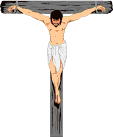 2:22-23; 4:8-10; 5:29-30; 10:39; 13:26-31), just as it had been the
centre of Jesus' ministry (Matt. 8:31-32; 20:17-19; Mark 9:31). It is also
clear that its meaning was not popular with the majority of his audience. Five
times Paul received 39 lashes from the Jews and he was stoned by the Gentiles
(2 Cor. 11:24; Acts 14:19-20). What was the message of the cross, and why was
it so unpopular? In the passage quoted above Paul referred to the message as
being a stumbling block to the Jews and foolishness to the Greeks. The Jews
were looking for the promised Messiah who would destroy their enemies and
establish God's kingdom on this earth (Psalm 2; 110:1; Isa. 11; Dan.
7:9-14; 9:25-26). The last thing they expected the Messiah to do was to be
crucified, because it is written in the Law that "...anyone who is hung on a
tree is under God's curse." (Deut. 21:23). Paul quotes the same verse in
Galatians 3:13 to prove that it was God's purpose for the Messiah to
suffer God's curse to free men from the curse of the Law (cf. 1 Peter
2:24). Other passages in the Old Testament clearly point to this side of
Jesus' ministry (Psalm 22:6-18; Isa. 52:13-53:12). Even John the Baptist
did not understand that the Messiah would come twice (Matt. 11:1-6, cf. Isa.
35:4-6; Luke 4:16-20, cf. Isa. 61:1), once to suffer for sins and a second time
to deliver his people (Heb. 9:26-28).
2:22-23; 4:8-10; 5:29-30; 10:39; 13:26-31), just as it had been the
centre of Jesus' ministry (Matt. 8:31-32; 20:17-19; Mark 9:31). It is also
clear that its meaning was not popular with the majority of his audience. Five
times Paul received 39 lashes from the Jews and he was stoned by the Gentiles
(2 Cor. 11:24; Acts 14:19-20). What was the message of the cross, and why was
it so unpopular? In the passage quoted above Paul referred to the message as
being a stumbling block to the Jews and foolishness to the Greeks. The Jews
were looking for the promised Messiah who would destroy their enemies and
establish God's kingdom on this earth (Psalm 2; 110:1; Isa. 11; Dan.
7:9-14; 9:25-26). The last thing they expected the Messiah to do was to be
crucified, because it is written in the Law that "...anyone who is hung on a
tree is under God's curse." (Deut. 21:23). Paul quotes the same verse in
Galatians 3:13 to prove that it was God's purpose for the Messiah to
suffer God's curse to free men from the curse of the Law (cf. 1 Peter
2:24). Other passages in the Old Testament clearly point to this side of
Jesus' ministry (Psalm 22:6-18; Isa. 52:13-53:12). Even John the Baptist
did not understand that the Messiah would come twice (Matt. 11:1-6, cf. Isa.
35:4-6; Luke 4:16-20, cf. Isa. 61:1), once to suffer for sins and a second time
to deliver his people (Heb. 9:26-28).
To the Greeks the cross was seen as an offence simply because the act of crucifixion was so horrific. Victims suffered in a agony for days before expiring, exposed to blazing sun and the ridicule of passers by. Although those of the cross often begged their tormentors to kill them it was impossible for them to kill themselves, because the struggle for breath became a reflex action.(1) How could a god die as a common criminal and have his followers proclaim the event as some sort of triumph?
Why Did Jesus Christ Die?
There are many factors involved in the death of Christ. The Jewish leaders, unable to refute his teaching and fearful of losing their positions of power, sought his death. They found the opportunity when Judas Iscariot, one of Jesus' disciples gave them the location of the place outside Jerusalem where Jesus would be spending the night. Having carried out a show trial before their leaders the turned the matter over to the civil authorities. While they were satisfied with the religious charges against Jesus, they needed to find something that would force the Governor to act. To this end they alleged that he had incited rebellion against Rome (Luke 23:2), something that the knew would force Pilate to act.
Pontius Pilate (governor of Judea 26-36 AD) was the man who officially sanctioned the crucifixion of Jesus. The Gospels make it clear that he knew that Jesus was innocent of any crime. He tried every tactic at his disposal to try and avoid doing what the Jewish leaders clearly wanted - to have Jesus judicially murdered. First Pilate tried to get the Jews to judge the matter themselves, but they refused as they had no legal power to execute someone (John 18:31). His next ploy was to send Jesus to Herod Antipas, because Jesus was from Galilee, but Herod sent him back (Luke 23:6-11). Stating that he found their charges groundless Pilate then offered to have Jesus flogged and released (Luke 23:13-16). The Jewish leaders were adamant, so Pilate gave them a choice between Jesus and Barabbas, a notorious insurrectionist and murderer and probably the worst prisoner Pilate had in custody at that time (Matt. 27:13-23). Reluctantly Pilate finally bowed to the inevitable and complied with their demands. He ordered that Jesus be crucified, declaring that he was not responsible for this death (Matt. 27:24-26).
It is very easy to pass the buck for Jesus' death, blaming Pilate, the Jews, or Judas. In the final analysis, however, we all have to face the fact that we all had a part in putting Him on the cross. Our sin made it necessary for Him to die, because it was the only way by which we could be brought back into relationship with Him (Eph. 3:1-7). The prophet Isaiah wrote that "...it was the Lord's will to crush him and cause him to suffer..." There was no other way but the cross for mankind to be saved from the consequences of sin. People often get offended about the exclusive claims that Jesus made about Himself being the only way to God (John 14:6, cf. Acts 4:12), but they have no right to be. It is an offence against God to suggest that He would allow Jesus to suffer if there was any other possible way that He could be reconciled with His creatures. Jesus understood that His life was a fulfilment of prophecy and set His face unswervingly to accomplish His goal.
The Recapitulation Theory
This is probably the oldest of the theories of the atonement (as the death of Jesus is known). Dating from the beginning of the second century it states that Jesus, the second Adam succeeded where the first Adam had failed. Jesus, by resisting temptation, living a sinless life and dying on the cross won back what the first Adam lost. While this theory is accurate as far as it goes, but is too narrow to express adequately all that the cross achieved.
The Ransom to Satan Theory
The idea that Christ died to buy mankind back from the power of Satan became popular during the 3rd century. It teaches that when Adam sinned he sided with the Devil and the authority God had given man over the world (Gen. 1:28) was transferred to Satan. Satan became the "god of this world" (Matt. 4:8-9=Luke 4:6-7; John 12:31; 14:30; 16:11; 2 Cor. 4:4; Eph. 2:2; 6:12; 1 John 5:18) and has the power of death (Heb. 2:14). Some writers even claimed that just as Adam was deceived by the serpent, God tricked Satan into killing Jesus, something that he had no authority to do because Jesus was without sin. Having succeeded in his deception Jesus rose from the dead and regained the authority that Adam had lost. While this theory takes seriously the existence and activity of Satan (cf. Luke 11:21) it goes too far, making him as powerful as God himself. Rather than offering a sacrifice to God (Eph. 5:2; 1 Tim. 2:5-6), the sacrifice is now offered to Satan.
This long-rejected theory has made a come back in recent years due to the teachings of the so-called "Faith Movement". According to Christian megastars Kenneth Hagin, Kenneth Copeland and their followers, when Adam fell God was totally excluded from this world.(2) God made a deal with a man called Abraham that one day would allow one of his descendants to win back power from the Devil.(3) Eventually Jesus was born and died on the cross, but it was during the three days that followed that the real work was done.(4) Jesus' spirit was tortured in hell for three days, but on the third day God revealed that Satan had been deceived into killing a sinless man(5) - over whom he had no legal right.(6) Jesus became born-again and wrested from Satan the keys of hell.(7)
While being extremely popular this teaching is founded not on Scripture as its proponents claim. Jesus triumphed over Satan from the cross, and surrendered his spirit into the hands of the Father (Luke 23:46; cf. John 19:30). He promised the dying thief that "today you will be with me in Paradise" (Luke 23:43) - not on his way to be tortured in hell. These details of Jesus' descent into hell have very little biblical support. 1 Peter 3:19 (cf. 2 Peter 2:4; Jude 6) refers to Christ's proclamation of victory to the spirits bound in prison, but contains nothing to suggest what the imaginations of the Faith Teachers have produced.
Dan McConnell provides a much-needed biblical response to the teachings described above:
Satan's dominion is… a usurped dominion. He stole it. He maintains it by accusation (Rev. 12:10), by deception (2 Cor. 4:4; Rev. 12:9), by enslavement to sin (2 Tim. 2:26), by the fear of death (Heb. 2:15), and by the power of death (Heb. 2:14; Rom. 5:17). In exercising his stolen dominion, Satan does use God's law for his own evil purposes, but he has no legal right of ownership of the world. God doesn't owe Satan a ransom. God owes Satan noting! (Nothing, that is, except eternal punishment in hell.)(8)
The power of sin and death which Satan has usurped are the result of man's transgression of God's Law. Christ removed these from the Devil's control when he freed mankind "the law of sin and death" (Rom. 8:2; cf. Col. 2:14-15).
Anselm's Satisfaction or Commercial Theory
 Anselm (1033-1109) AD) was made Archbishop of Canterbury following
the Norman conquest. His theory of the atonement relied heavily on the feudal
system of his day, in which serfs worked on an estate for an overlord. The
overlord - a knight - protected the estate from attack. The knight in turn had
to honour the King. The serfs owed the knight a debt of honour for their
protection and livelihood. Anselm pictured God as the overlord of the world to
whom is owed a debt of honour. Failure to honour God is therefore a sin. God
cannot overlook such an offence and demands satisfaction. While it is man who
owes such a debt to God, the only person capable of paying the debt is God
himself. God therefore became man so that he himself could satisfy God's
offended character. Christ's death accrued a superabundance of merit (also
known as supererogation) which is now available for distribution to
those who believe.
Anselm (1033-1109) AD) was made Archbishop of Canterbury following
the Norman conquest. His theory of the atonement relied heavily on the feudal
system of his day, in which serfs worked on an estate for an overlord. The
overlord - a knight - protected the estate from attack. The knight in turn had
to honour the King. The serfs owed the knight a debt of honour for their
protection and livelihood. Anselm pictured God as the overlord of the world to
whom is owed a debt of honour. Failure to honour God is therefore a sin. God
cannot overlook such an offence and demands satisfaction. While it is man who
owes such a debt to God, the only person capable of paying the debt is God
himself. God therefore became man so that he himself could satisfy God's
offended character. Christ's death accrued a superabundance of merit (also
known as supererogation) which is now available for distribution to
those who believe.
Anselm's theory takes seriously the gravity of sin and the holiness of God. Unfortunately it goes beyond what the Bible teaches and reads in too much of a culture foreign to the Scriptures. The satisfaction of God's character that is described is totally external to the individual believer. There is no personal response involved or any change worked on the individual.
The Moral Influence Theory
 Peter Abelard (1079-1142 AD) of Paris reacted against the coldly
clinical nature of Anselm's satisfaction theory. Abelard's theory
sees Christ's death not as a sacrifice or payment of any kind, but rather
as the supreme example of God's love for us. From the example set by Jesus
we are thus inspired to love God and one another. The key text used to support
this theory is 1 Peter 2:21-23, but closer study reveals that this verse speaks
about Jesus' example as an inspiration to believers to endure hardship for
the sake of their faith, not to inspire unbelievers to believe! This view is held today by many Unitarians.
Peter Abelard (1079-1142 AD) of Paris reacted against the coldly
clinical nature of Anselm's satisfaction theory. Abelard's theory
sees Christ's death not as a sacrifice or payment of any kind, but rather
as the supreme example of God's love for us. From the example set by Jesus
we are thus inspired to love God and one another. The key text used to support
this theory is 1 Peter 2:21-23, but closer study reveals that this verse speaks
about Jesus' example as an inspiration to believers to endure hardship for
the sake of their faith, not to inspire unbelievers to believe! This view is held today by many Unitarians.
Penal Substitutionary Atonement
Paul wrote to the Corinthians that "Christ died for our sins according to the Scriptures..." The cross was not an afterthought on God's part, but had been planned from the beginning (Rev. 13:8). As soon as Adam and Eve sinned the Lord gave a graphic illustration of what would one day happen. He took an animal, killed it and covered the nakedness of the man and his wife (Gen. 3:21). Later God commanded Abraham to sacrifice his only son on an altar, then, at the last minute, he stopped him and Himself provided a sacrifice. Abraham declared that on the mountain of the Lord (Mt. Moriah) it will be provided (22:1-14). A third foreshadowing of the cross occurred during the desert wanderings of Israel. The people had grumbled against the Lord, so He sent venomous snakes to bite them. When the people cried out for help He commanded Moses to make a bronze snake and hang it on a pole. All those who looked at the snake were healed. During His earthly ministry Jesus himself declared that one day he would repeat that act. Instead of a snake, this time the source of man's problems - man himself - would be lifted up (John 3:14-15).
By far the clearest foreshadowing of the cross can be seen in the old testament sacrificial system. Sin excluded man from God's presence and no one could approach his presence without the shedding of blood. This meant that only the high priest was allowed to enter the Holy of Holies within the tabernacle where the God manifested his shikinah glory, and he was only allowed to do so once a year Lev. 16). The book of Hebrews explains how the sacrificial system was fulfilled and superseded by the death of Christ. In chapters 9-10 the writer explains how Christ offered himself as the perfect sacrifice for sin once and for all. It is his shed blood that cleanses the believer in a way that that was impossible under the old covenant.
The Bible uses several technical terms to describe what Jesus
achieved on the cross. His death was the price paid buy or redeem us.
mankind is said to have been "bought" (1 Cor. 6:20; 7:23; 2 Peter 2:1; Rev. 59:
14:3-4), "redeemed" (Gal. 3:13; 4:5) and "acquired" (Acts 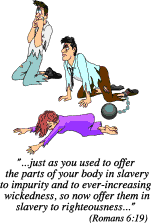 20:28). Mankind was redeemed (or bought back)
from life under the curse of having to live under the Law, because no one can
fully obey the Law (Deut. 27:26) and the penalty for failure is death (Gal.
3:10-14). The result of this purchase is that we are now owned by God and
therefore have an obligation to do what pleases Him (Rom. 6:19). We are worth
what is cost to buy us. It is a paradox that slavery to God is true freedom
(John 10:10; Gal. 5:1) Another group of Greek words add to our understanding of
the term redemption. In Luke 24:21 the word translated "redeem" in the NIV is used of the deliverance of the nation of Israel from the tyranny
of Rome, Paul uses it to describe freedom from bondage to sin (Titus 2:14) and
Peter speaks being freed from an "empty way of life" (1 Peter 1:18). Matthew
20:28 and Mark 10:45 speak of the death of Christ as a ransom. This
ransom brings justification which is a legal declaration of right
standing before God (Rom. 3:24). In Ephesians the redemption is linked
with the forgiveness of sin (1:7) at the cost of Christ's blood. By
definition their can be no redemption of people without the payment of a
price.(9) God cannot simply right-off the debt. Two Old
Testament examples are helpful at this point. Both Ruth the Moabitess and Gomer
the wife of Hosea had to be redeemed. Ruth was purchased by Boaz for the price
of the land owned by he father-in-law Elimelech (Ruth 4:2-4). Gomer was bought
out of slavery for fifteen shekels and a home and a lethek of barley (Hosea
3:2).
20:28). Mankind was redeemed (or bought back)
from life under the curse of having to live under the Law, because no one can
fully obey the Law (Deut. 27:26) and the penalty for failure is death (Gal.
3:10-14). The result of this purchase is that we are now owned by God and
therefore have an obligation to do what pleases Him (Rom. 6:19). We are worth
what is cost to buy us. It is a paradox that slavery to God is true freedom
(John 10:10; Gal. 5:1) Another group of Greek words add to our understanding of
the term redemption. In Luke 24:21 the word translated "redeem" in the NIV is used of the deliverance of the nation of Israel from the tyranny
of Rome, Paul uses it to describe freedom from bondage to sin (Titus 2:14) and
Peter speaks being freed from an "empty way of life" (1 Peter 1:18). Matthew
20:28 and Mark 10:45 speak of the death of Christ as a ransom. This
ransom brings justification which is a legal declaration of right
standing before God (Rom. 3:24). In Ephesians the redemption is linked
with the forgiveness of sin (1:7) at the cost of Christ's blood. By
definition their can be no redemption of people without the payment of a
price.(9) God cannot simply right-off the debt. Two Old
Testament examples are helpful at this point. Both Ruth the Moabitess and Gomer
the wife of Hosea had to be redeemed. Ruth was purchased by Boaz for the price
of the land owned by he father-in-law Elimelech (Ruth 4:2-4). Gomer was bought
out of slavery for fifteen shekels and a home and a lethek of barley (Hosea
3:2).
We have learned so far that the Cross was an act of redemption, the deliberate buying back of people on the payment of a price. The price paid was the blood of Jesus shed on the Cross, but what was the price paid for? We noted above that it was to free us from the curse of the Law, but that is not the whole story. The price was paid to God in order to turn aside His anger towards sin (Romans 3:25; 1 John 2:2; 4:10; Heb. 2:17). This doctrine, known as the doctrine of propitiation, is unpopular today because many people feel that it is contrary to the character of a loving heavenly Father to be angry with sin and demand a sacrifice to satisfy his righteousness. This argument seems to be based on a false dichotomy between the Old and the New testaments. God's character has not changed. The God and Father of our Lord Jesus Christ is also the God of Abraham, Isaac and Jacob. The God who as angry at Israel's sin during her wilderness wanderings still feels that same was towards sin today.(10) A noted New Testament scholar explains the tension between God's love and his anger against sin this way:
There is a divine wrath, but if we may put it this way, it is always exercised with a certain tenderness. Even when He is angry with man's sin God loves man and is concerned with his well-being in the fullest sense. There is a divine love, but it is not a careless sentimentality indifferent to the moral integrity of the loved ones. Rather it is a love which is a purifying fire, blazing against everything that hinders the loved ones from being the very best that they can be.(11)
God's wrath is not selfish or vindictive but an expression of his perfect holiness. Rather than destroying man as he deserved the Bible reveals how He provided an means by which His holiness could be satisfied and sin dealt with. That means was the Cross of Christ.
Caught in Between the Now and the Not-Yet
That Christ's work was finished upon the cross is beyond question. His dying words make that crystal clear (John 19:30). This creates a problem for many as they read through the Bible, because of the extent of what was said to have been achieved. In recent years many have claimed that to be a Christian means that you can expect all of the benefits of the cross in this life. This means that every Christian should be rich, never experience sickness of any kind and die in their sleep between the ages of 70 and 120.(12) Pointing to Isaiah 53:4-5 (cf. Matt. 8:17; 1 Peter 2:24) they argue that healing is as readily available to the believer as salvation. Closer study of these passages, however, shows up some weaknesses in this argument. 1 Peter 2:24 (citing Isa. 53:5) refers to spiritual rather than physical healing. The word "healed" in Isa. 53:5 might also be translated "forgiven" as it is in 6:10 and Jer. 3:22 & 30:17 and still fit the Hebrew parallelism. Isa. 53:4 and Matthew 8:17 do refer to physical healing and this healing is therefore in the Atonement, just as our resurrection bodies (1 Cor. 15:51-55), the defeat of Satan (Heb. 2:14), the end of death (1 Cor. 15:25-26; Heb. 2:15) and the reversal of the Adamic curse of nature (Gen. 3:17-19; cf. Rev. 21:1-5; 22:1-3) are in the Atonement. No one would question (except the Christian Scientists) that we still experience death, do not yet have a resurrection body and continue to struggle against Satan and his forces (Eph. 6:10-18).
The New Testament shows us that the early Christians did not experience total freedom from sickness. In Romans 8 Paul describes the struggle that believers experience because of the continuing effects of the Fall (18-26; cf. 2 Cor. 4:16), but promises that one day our bodies will be delivered from this pain (v.23). Paul himself was ill at times (Gal. 4:13-14), as were his fellow-workers Timothy (1 Timothy 5:23), Trophimus (2 Timothy 4:20) and Epaphroditus (Phil 3:25-27). Paul says in Ephesians 1:14 that our redemption has not yet been fully realised and it is clear that certain aspects of Christ's work are still future. Healing is not guaranteed, but is available as a gift from God which He sovereignly bestows as He sees fit (1 Cor. 12:9).
The idea that believers can claim everything that was achieved on the Cross today is not a new one, the believers at Corinth made the same mistake (1 Cor. 4:8). Paul has to point out that there is a future perspective: Jesus is yet to be revealed (1:7); a time is still to come when the saints will judge angels (6:3) and the believers conscience will be judged by the Lord (4:4-5).(13) Amy Grant puts explains the situation we face in her song "The Now and Not-Yet" .Until the Lord comes again we live in a tension in which we taste of the powers of the age to come (Heb. 6:5), but do not yet enter into them fully (1 Cor. 13:8-12; 1 John 3:2-3). We are called to press in and take as much as we can in this age (Phil 3:12), while at the same time not making up simplistic and unbiblical explanations about why we do not experience everything that we would like to.(14)
The
Challenge of the Cross
The message of the cross is still as offensive to modern man as it was to those in the first century. People would rather believe anything and do anything rather than accept salvation as a gift from God. A proper understanding of the meaning of the Cross is essential to the process of sanctification - the gradual development of the Christ-like character in a believer (Gal. 5:22-23). Christians are not commanded to live good lives because of the threat of punishment if they fail, but because of the extent of what Christ's has already done of their behalf. As Thomas Erskine put it: "in the New Testament, religion is grace, and ethics is gratitude."(15) The New Testament writers often linked believer's understanding of the Cross and his sanctification, pointing to Jesus' example and demanding a response in terms of personal ethics or right living, e.g. 1 Peter 1:17-19; 2:24; 4:1-3; 1 John 4:10-11. The message is clear: once we understand clearly how much Jesus had to suffer to pay the price for our sins, we will strive to obey Him out of gratitude.
We are not to use our freedom to indulge ourselves (Gal. 5:13), but to become holy (1 Thess. 4:3) and to achieve the purpose God has for us (Eph. 2:8-10). This will involve each of us paying a price in our efforts to fulfil this purpose. Jesus said that all who would follow him should take up their Cross daily and follow him (Matt. 10:34-39; 16:24-25; Luke 9:23). In saying this Jesus was not referring to some personal problem, arthritis or a congenital heart defect, to a conscious renunciation of everything that would oppose against God's will in our lives. A.W. Tozer makes it clear that the taking up of the Cross is not done casually or half-heartedly, because the
...cross is a symbol of death. It stands for the abrupt, violent death of a human being. The man in Roman times who took up his cross and started down the road had already said good-by to his friends. He was not coming back. He was going out to have it ended. The cross made no compromise, modified nothing, spared nothing; it slew all of the man, completely and for good. It did not try to keep on good terms with its victim. It struck cruel and hard, and when it had finished its work, the man was no more.(16)
Paul wrote to the Galatian Christians: "Those who belong to Christ have crucified the sinful nature with its passions and desires." (Gal. 5:24). May that be true of us today.
© 1995 Robert I. Bradshaw
References
(1) John R.W. Stott, The Cross of Christ. (Downers Grove, Ill.: IVP, 1986), 23-24: "Crucifixion seems to have been invented by 'barbarians' on the edge of the known world, and taken over from them by both Greeks and Romans. It is probably the most cruel method of execution ever practised, for it deliberately delayed death until maximum torture had been inflicted. The victim could suffer for days before dying. When the Romans adopted it, they reserved it for criminals convicted of murder, rebellion or armed robbery, provided that they were also slaves, foreigners or other non-persons."
(2) Kenneth Copeland, "Image of God in You III" (Fort Worth, Texas: Kenneth Copeland Ministries, 1989), audiotape #01-1403, side 1, cited in Hank Hanegraaff, Christianity in Crisis. (Eugene, Oregon: Harvest House Publishers, 1993), 132, note 6: "God's on the outside looking in, He doesn't have any legal entrée into the earth. The thing doesn't belong to Him. You see how sassy the Devil was in the presence of God in the book of Job? God said, Where have you been? Wasn't any of God's business. He [Satan] didn't even have to answer if he didn't want to… God didn't argue with him a bit! You see, this is the position that God's been in.… Might say, "Well, if God's running things He's doing a lousy job of it." He hadn't been running 'em, except when He's just got, you know, a little bit of a chance."
(3) Frederick K.C. Price, "Ever Increasing Faith" program on TBN (1 May 1992), audiotape #PR11, cited in Hanegraaff, 381, note 26: "Adam, as I said, gave it (the earth) away to the serpent, to the Devil. As a result of it, he got his behind kicked out of the garden. He went out of Eden, out of the garden. He began to wander around, and he has troubles from day one. Now God was out of the business. God was out of the earth realm. God had no more stock in this earth realm. No more. None at all. Nothing he could do. Not a thing in the world He could do.… The only way God could get back into this earth realm, He had to have an invitation. Ha-Hah' He had to have an invitation. And so, God looked around - saw different men, saw Noah, saw different ones. He gave them a few instructions. They did what He said. So and so and so and so. But, finally, He got to a point where He had His plan ready for operation. And He saw a man named Abraham."
(4) "Jesus went into hell to free mankind from the penalty of Adam's high treason… When His blood poured out it did not atone.… Jesus spent three horrible days and nights in the bowels of this earth getting back for you and me our rights with God." Personal letter from Kenneth Copeland, Ft. Worth, Texas, March 12, 1979, cited by McConnell, 120. Italics added.
(5) Kenneth Copeland, "What Happened from the Cross to the Throne." (Fort Worth, Texas: Kenneth Copeland Ministries, 1990), audiotape #02-0017, side 2, cited in Hanegraaff, 26, n. 49: "Satan didn't realise He [Jesus] is in there [hell] illegally.… This man had not sinned. This man has not fallen out of the covenant of God, and He had the promise of God for deliverance. And Satan fell into the trap. He took him into hell illegally. He carried Him in there [when] He did not sin."
(6) Charlie Capps, Authority in Three Worlds, 143, cited in Hanegraaff, 26, n. 50: "When Jesus was in the pit of hell, in that terrible torment, no doubt the Devil and his emissaries gathered around to see the annihilation of God's Son. But in the corridors of hell, there came a voice from heaven: "Turn Him Loose! He's there illegally!" And all of hell became paralysed." Emphasis in original.
(7) Kenneth Copeland, "The Price of it All," Believer's Voice of Victory 19, 9 (September 1991): 4-6, cited in Hanegraaff, 26, n. 53: "He [Jesus] was literally being reborn before the devil's very eyes. He began to flex His spiritual muscles.… Jesus was born again - the firstborn from the dead the Word calls Him - and He whipped the Devil in his own backyard. He took everything he had away from him. He took his keys and his authority away from him."
(8) D.R. McConnell, A Different Gospel: A Historical and Biblical Analysis of the Modern Faith Movement. (Peabody, Mass.: Hendrickson Publishers, 1988), 126.
(9) Leon Morris, The Apostolic Preaching of the Cross, 3rd revised edition, 1965. (Grand Rapids: Eerdmans Publishing Co., 1988), 21.
(10) Morris, 150: "There is a consistency about the wrath of God in the Old Testament. It is no capricious passion, but the stern reaction of the divine nature towards evil. It is aroused only and inevitably by sin. This may be thought of in general terms (Jb. 21:20; Je. 21:12; Ezk. 24:13), or it may be categorised more exactly as the shedding of blood (Ezk. 16:38; 24:8), adultery (Ezk. 23:25), violence (Ezk. 8:18), covetousness (Je. 6:11), revenge (Ezk. 25:17), afflicting widows and orphans (Ex. 22:23f.), taking brethren captive (2 Ch. 28:11-13), etc. Wrath comes upon Israel because of the evil of Jeroboam as repeated by Jehoahaz (2 Ki. 13:3), and because of the evil of Manasseh (2 Ki. 23:260, while Moses feared that the desire of the two and a half tribes not to pass over Jordan would have a similar effect (Nu. 32:14). Profaning the sabbath arouses wrath (Ne. 13:18), which comes also upon men who 'have not told the truth about' God (Jb. 42:7, Moffatt), and Gideon feared that his repeated testing of the Lord would cause God's anger (Jdg. 6:39).
(11) Morris, 176.
(12) Kenneth Hagin, "Healing: The Father's Provision," Word of Faith. (August, 1977): 9: "I believe that it is the plan of God our Father that no believer should ever be sick. That every believer should live his full length of time and actually wear our, if Jesus tarries, and fall asleep in Jesus. It is not - I state boldly - it is not the will of God my Father that we should suffer with cancer and other dread diseases which bring pain and anguish. No! It is God's will that we be healed." Cited by McConnell, 157.
(13) Anthony C. Thiselton, "Realised Eschatology at Corinth," New Testament Studies, Vol. 24 (1977): 10-26.
(14) The callousness of the perveyors of the Health & Wealth Gospel in this regard has to be seen to be believed. Here is a sample from Frederick Price: "...how can you glorify God in your body, when it doesn't function right? How can you glorfy God? How can He get glory when your body doesn't work?… What makes you think the Holy Ghost wants to live inside a body where He can't see out through the windows and He can't hear with the ears? What makes you think the Holy Spirit wants to live inside of a physical body where the limbs and organs and the cells do not function right?… And what makes you think He wants to live in a temple where He can't see out of the eyes, and He can't walk with the feet, and He can't move with the hand?… The only eyes that He has that are in the earth realm are the yes in the body. If He can't see out of them then God's gonna be limited...." Frederick K.C. Price, "Is God Glorified Through Sickness?" (Los Angeles: Crenshaw Christian Center, n.d.), audiotape #FP605, cited in Hanegraaff, 259-260.
(15) Thomas Erskine, Letters. (Edinburgh, n.p., 1877), 16, cited by F.F. Bruce, Paul: Apostle of the Free Spirit, 1977. (Carlisle: Paternoster Press, 1992), 19.
(16) A.W. Tozer, "The Old Cross and the New," Compiled by Anita M. Bailey, Man: The Dwelling Place of God. (Camp Hill, Penn.: Christian Publications, 1966), 43-44.