






Theology on the Web helps over 2.5 million people every year to find high quality theological resources that will help to equip them to serve God and to know Him better (2 Timothy 2:15). Like other websites that provide free services, it is dependent on donations to enable it to grow and develop and only 0.004% of visitors currently do so. If you would like to support this site, please use one of the options to the right of this message.
Introduction
As an observer of the creation / evolution debate for several years I have noticed two extreme positions being taken over the degree to which our humanity affects our understanding. Some popular presentations of evolution (those by David Attenborough spring to mind) present science as totally objective and clear cut: the 'facts' of science cannot mean anything else than what the majority of scientists affirm. The Bible, on the other hand, is a religious book and therefore what it means is a matter of interpretation - in other words it can mean anything you want it to mean. Some creationists take the exact opposite view: it is science that is subjective, but the Bible cannot mean anything else than what creationists say it means.
Both extremes have an element of truth in them, but both are misleading. In the following article I will examine some of the issues involved in the interpretation of both the Bible and nature. It is my hope that it will help creationists in particular to better understand the subject of biblical hermeneutics.
The Interpretation of Scripture
It is generally acknowledged that since the beginning of the twentieth century advances in the art and science of interpretation (or hermeneutics as it is known) have greatly enhanced our understanding of the Scriptures.(1) Briefly stated the purpose of interpretation is to discover what God was saying to the original recipients of Scripture and then apply that in our lives today.(2) It is important to stress that the discovery of the text's intended meaning is not the end of the process, but the beginning. The interpretation of Scripture is not complete until its application is found for the reader in his or her present situation (Osborne, 1992: 12; Packer, 1983: 345-346). Modern hermeneutics follows closely the historical method of exegesis practised by the Antiochenes (Thiselton, 1980: 115; Dockery, 1991: 58-59) such as Theodore of Mopsuestia (ca 350-428), John Chrysostom (374-407). and later by the Reformers Martin Luther and John Calvin (Johnson, 1990: 11).
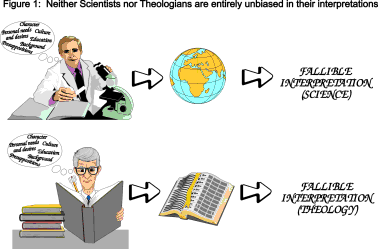
In order to discover the text's intended meaning the reader has to recognise the temporal and cultural distance between him or herself and the human writer of Scripture Thiselton, 1980: 11). This means that when we come to the text we must recognise that we invariably read into it (consciously or unconsciously) our individual world-view, consisting of our "background, education, presuppositions, culture, character, needs and desires" (Bromiley, 1979: 64). These presuppositions are likely to be very different from those of the original readers of, for example, one of Paul's letters. This does not mean that we can never understand the meaning of a text (as some have claimed) because it is possible to bridge the distance between modern reader and the original audience by means of a consistent hermeneutic.(3) As we read the Scripture and learn more about the situation of the people to whom it was originally addressed we are changed by it and so our presuppositions change. The process of interaction between reader and text is called the hermeneutical circle by many writers. However, it is better described as the hermeneutical spiral because by continued interaction with the text the reader 'spirals' nearer and nearer to the author's intended meaning (Thistleton, 1980: 104, 439; Packer, 1983: 348-349; Osborne, 1991: 6).
Creationist Professor John Rendle-Short provides an example of the hermeneutical spiral in action. He argues that God could not have used evolution because it states in Genesis that God defined His creation as "good". Rendle-Short points out that the presence of cruelty and death inherent in an evolutionary process could never be defined as being "good". In effect he is saying that our interpretation of Scripture must be consistent with the character of God.(4) So it follows that in order to check whether your understanding of a biblical text is correct, you must understand the character of God. Everyone has their own idea of what God is like, but the only source of objective information about God's character is the Bible itself. Therefore, as you read the Bible you learn what God is like and have the ultimate standard to judge what "good" is.
Creationist Suspicion of Hermeneutics
This description of the process of interpretation has been treated with suspicion in some quarters because it appears to undermine the doctrine of infallibility of the Scripture.(5) The problem is caused by a confusion of the infallibility of the text with that of the interpretation. While the Scripture is infallible our understanding of its meaning (that is, our theology) is not. Only by careful application of the rules of hermeneutics can we reach the true meaning of Scripture. The rejection by some of the Church's historic position that the Bible is authoritative when it mentions issues relating to the natural world owes much to interpretations that were wrongly attributed to Scripture, such as a geocentric cosmology. In that particular case a point of crisis was reached when the accuracy of the official interpretation of Scripture could no longer be upheld. People associated the accuracy of the interpretation with accuracy of Scripture, so both were rejected. Augustine of Hippo (354-430) warned Christians of his day of this danger:
In matters that are obscure and far beyond our vision, even in such as we may find treated in Holy Scripture, different interpretations are sometimes possible without prejudice to the faith we have received. In such a case, we should not rush in headlong and so firmly take our stand on one side that, if further progress in the search for truth justly undermines this position, we too fall with it. That would be to battle not for the teaching of Holy Scripture but for our own, wishing its teaching to conform to ours, whereas we ought to wish ours to conform to that of Sacred Scripture. (Augustine, 1982: 39).
Table 1: Disagreements Among Leading Creationists Over Biblical Interpretation
No. |
SUBJECT |
INTERPRETER |
|||||
John Calvin |
Henry M. Morris |
E.J. Young |
E.H. Andrews |
David Rosevear |
David C.C. Watson |
||
1 |
Was there death before the Fall? |
No (human) [127] |
No [Record, 127] |
? |
Yes (animal & vegetable) [Science, 82] |
No (Creation, 18) |
Yes (Vegetable) (Myths, 64-65) |
2 |
God physically formed Adam with his hands (Gen. 2:7) |
? |
Yes [Record 87] |
No [Beginning, 68] |
? |
? |
? |
3 |
God physically breath into Adam (Gen. 2:7) |
? |
Yes [Record, 85-86] |
No [Beginning, 69] |
? |
? |
? |
4 |
Who walked in the garden with Adam & Eve? (Gen. 3:8) |
God manifested as wind [161] |
The pre-incarnate Christ [Record, 116] |
The pre-incarnate Christ [Genesis, 74] |
? |
? |
? |
5 |
Who were/are the "offspring of the serpent"? (Gen. 3:15) |
? |
Evil men [Record, 121] |
Evil spirits [Genesis, 116]; Evil men [Beginning, 106] |
? |
? |
Snakes (Myths, 66) |
6 |
The Bible contains a complete genealogy. (Gen. 11) |
Yes [335-336] |
No [Flood, 481-483] |
? |
No [Science, 73] |
Yes [Creation, 149-150] |
Yes (Robbery, 93-96). |
7 |
Who were the "Sons of God" (Gen. 6:1-4)? |
Descendants of Cain [237-239] |
Angels [Record, 164-170] |
? |
? |
? |
Not angels [Personal communication] |
?=No view expressed in writings.
John Calvin, Genesis, trans. John King, 1965. London: Banner of Truth Trust, 1992; John C. Whitcomb & Henry M. Morris, The Genesis Flood. The Biblical Record and its Scientific Implications, 1961. (Grand Rapids: Baker Book House, 1981); Henry M. Morris, The Genesis Record: A Scientific & Devotional Commentary on the Book of Beginnings. Grand Rapids: Baker Book House, 1976; E.J. Young, Studies in Genesis One. Philadelphia: Presbyterian & Reformed, 1964); Genesis 3: A Devotional & Expositional Study. (London: Banner of Truth, 1966); In The Beginning. Genesis Chapter 1 to 3 and the Authority of Scripture, 1976. (London: Banner of Truth Trust, 1984 reprint); E.H. Andrews, God, Science & Evolution. (Welwyn: Evangelical Press, 1980); David T. Rosevear, Creation Science: Confirming That The Bible is right. (Chichester: New Wine Press, 1991); David C.C. Watson, Myth and Miracles? (Worthing: Henry Walker, 1976); The Great Brain Robbery (Cambridge: Privately Published, 1989 reprint).
Some argue that hermeneutics is unnecessary because of the work of the Holy Spirit in illuminating Scripture to the believer. The variety of interpretations of the Scriptures regarding baptism, the role of women in the ministry and the gifts of the Spirit, all held by equally sincere believers should be sufficient evidence to show that such a theory is flawed. In addition it often leads to spiritual pride whereby those who have had the "revelation" of a particular point see themselves as being superior to those who have not.(6) The role of the Holy Spirit in illuminating Scripture is not to replace the rational process of interpretation or to provide us with new information (Thistleton, 1980, 90-92). Rather the Holy Spirit helps us to overcome the effects of sin in the rational process and overcome our preunderstandings so that we "remain open to further leading from the Spirit and challenge from our peers." (Osborne, 1991: 341).(7) In addition to this role the "...Spirit convinces God's people of the truth of the biblical message and convicts and enables them to live consistently with that truth."(8)
The subject of hermeneutics is given very little attention in books by creationists. Henry M. Morris rejects the need for a hermeneutic and implies that those are practice it are of doubtful orthodoxy when he writes:
We do not question that God "speaks" through His creation, but such natural revelation must never be considered equal in clarity or authority to His written revelation, especially as it is often "interpreted" by fallible human scholars, many of whom do not even believe the Bible. The Scriptures, in fact, do not need to be "interpreted" at all, for God is well able to say exactly what He means. They need simply to be read as the writer intended them to be read, then believed and obeyed. (Morris, 1984: 47).
As I have pointed out already the point of "interpretation" is to achieve exactly what Henry Morris wants - the correct application of the author's intended meaning. Most creationist writers, like Morris, state that the Genesis account should be interpreted literally (Lubenow, 1992: 146). Some add that phenomenological language and figures of speech be taken into account (Gitt, 1986: 27) and appeal to the perspicuity of Scripture(9) (the principle that states that the Bible is sufficiently clear for all believers to understand it). However, as Walter C. Kaiser points out, the principle of perspicuity is often misapplied:
...this principle may be overextended if it is used as an excuse against further investigation and strenuous study by believers who are not contemporaries of the prophets and apostles who first spoke the word of God. Scripture, in any faithful translation, is sufficiently perspicuous (clear) to show us our sinfulness, the basic facts of the gospel, what we must do if we are to be part of the family of God, and how to live for Christ. This does not mean, however, that in seeing (and even understanding) these truths we have exhausted the teaching of Scripture. Neither does it imply that the solution to every difficult question in Scripture or life is simple, much less simplistic. It only affirms that, despite the difficulties we find in Scripture, there is more than enough that is plainly taught to keep all believers well nourished. (Kaiser, 1980: 128).
In one of the better treatments of hermeneutics by a creationist, Professor E.H. Andrews notes the importance of literary genre, figurative language and the priority of the author's intended meaning (Andrews, 1986: 80-86). However, he goes on to imply that it is only theistic evolutionists who approach the text with presuppositions that differ from those of the text's author (Andrews, 1986, 86). The fact that equally sincere creationists can still produce totally different 'literal' meanings from the same text indicates that interpreting the Bible is not as easy as some suggest. Table 1 shows the variety of interpretations made by creationists of key verses in the early chapters of Genesis. Marvin Lubenow draws attention to the abuse of hermeneutics with regard to the Genesis account of creation, but makes no positive comment about the need for a good hermeneutic (Lubenow, 1992: 239). In contrast John Barton Payne, in an article cited by Lubenow, underlines the dangers of bad interpretation, but made it clear that hermeneutics "...is in fact indispensable for proper exegesis and becomes detrimental to Biblical truth only when perverted into what Engelder has called 'the hermeneutics of the moderns'." (Payne, 1960: 93)
As a result of the general suspicion creationists have not engaged with biblical hermeneutics, leaving theistic evolutionists to dominate the field, something which I for one find extremely worrying. Gordon Fee & Douglas Stuart point out that "[t]he antidote to bad interpretation is not no interpretation, but good interpretation, based on common-sense guidelines." (Fee & Stuart, 1993: 17). The time has come for creationists to realise that the science and art of hermeneutics is not a threat, but actually supports their position. Likewise we all have to realise that we have presuppositions when we read the Bible. The recognition of or presuppositions is essential if we are to allow for them in our exegesis.
In attending creationist seminars I have often been surprised by poor exegesis practised by the speakers. One of the key principles of the Reformers hermeneutic was that "scripture interprets scripture". However, this dictum is open to abuse if the exegete relies simply on the use of the same word in two passages and ignores the words meaning in its context. At one seminar that I attended in 1995 the speaker asked the audience how many days God created, and then answered it by saying that He only created one day, because after the earth was made and turning on its axis no further creative act was necessary to make another day. The speaker then proceeded to "prove" his point by cross-referencing Genesis 1 with Psalm 118:24: "This is the day that the Lord has made; let us rejoice and be glad in it." (NIV, emphasis mine). He assured his audience that the "day" mentioned in the Psalm was not the "day" on which it was being sung, but referred instead to the creation of the first day. The fact is, however, that the day mentioned in Psalm 118 does refer to that day of rejoicing on which the Psalm is being sung and not to Genesis 1. Nowhere in the context is there any hint that the author of the Psalm had anything other than this in mind. In order for "Scripture to interpret Scripture" the cross-references must be alike in the person, object or concept they are describing, not just because they use the same word.
Hermeneutics & The Creation / Evolution Debate
This leads me to make the following points regarding the present creation/evolution debate:
-
In recent years creationists have been extremely successful in publicising the scientific evidence for their views. However, this success has not been balanced by a recognition of the science of biblical hermeneutics. Creationist speakers and writers, who are mostly scientists with little or no theological training need to give more attention to good exegesis and not simply dismiss those who attempt to practice it as "liberals" when this is clearly not the case.
-
Our interpretation of Scripture is significantly affected by our presuppositions. An evolutionary world view will always have difficulty accommodating biblical statements concerning Adam's position as the first man, the origin of sin and the universality of the Flood. It will also profoundly affect those doctrines which are based upon a historical understanding of Genesis 1-11. Such doctrines include marriage, sexuality and human mortality.
-
A knowledge of the history of the way Christians have interpreted Genesis 1-11 enables us to recognise how an interpreter's presuppositions affected what he wrote about Genesis. It is easier, with the benefit of hindsight, to see how Origen's Neoplatonism led inevitably to what he wrote about creation. It is less easy to recognise our own prejudices. Such knowledge also enables us, as Anthony Thistleton notes, to draw upon those "interpretations and insights that have stood the test of time." (Thistleton, 1980: 439)
-
The histories of science and of the interpretation of Scripture, together with the principles of hermeneutics all teach us that it is unwise to commit oneself too strongly to a particular "scientific" interpretation. Examples can be given on both sides of the debate. On the Evolutionist side the existence of Nebraska man (Hesperopithecus haroldcookii) (Johnson, 1991: 5-6) and Piltdown man (Eanthropus dawsoni) (Bowden, 1977:3-55) were for a time accepted as a fact. Creationists, for their part, have in the past pointed to the Paluxy River footprints (and some, regrettably, still do) (Whitcomb & Morris, 1961: 166-169; Morris, 1984: 353-354).(10) This does not mean that creationists should never make use of scientific data, but rather that they should do so more cautiously.
Having looked at the principles of biblical interpretation, we will now briefly summarise the interpretation of the natural world by modern science. As will become obvious shortly, there is a strong parallel between the two.
The Interpretation of Scientific Data
Up to the 1960's the empirical method of the Baconian understanding of science assumed total objectivity on the part of the scientist. The human failing of the scientist were excluded by strict adherence to inductive logic, which (it was thought) was all that was required to discover the laws of nature. This is the definition of science that is popularly presented today, and which is reflected in most dictionary references to the word. As science developed it was realised that the inductive method was inadequate when it came to attempting to explain things that involved the unobservable, such as magnetic fields, subatomic particles and the distant past. It was realised that there is no direct link between data and a theory that attempts to account for them. The successor to inductive science, Hypothico-Deductivism fared no better. This worked by testing the validity of any theory whatever its source according to the results it predicted. If an experiment achieved the predicted results then the theory was assumed to be accurate. Perhaps the most telling criticism of this method was that there are potentially an infinite number of theories that might explain a given set of data. The selection of the most satisfactory theory is therefore determined on the basis on nonempirical factors, which allows an element of subjectivism to enter the process. The principle of falsification also failed as a means of establishing the truth of a theory. In practice it is impossible to be sure whether an experiment failed to provide the result predicted by a theory because the theory was wrong or because of some other reason, such as inadequate equipment. (Ratzsch, 1996: 103-115).
In 1962 Thomas Kuhn demonstrated in his book The Structure of Scientific Revolutions that the views of science discussed above were untenable. He pointed out that the gathering of data does not lead inevitably to a specific scientific theory to explain it (Kuhn, 1962: 4). Instead the world-view of the scientist observing the experiment played a part in the selection of a theory to interpret the evidence. Kuhn proposed that science developed by means of paradigm shifts. A paradigm can be thought of as a conceptual framework for interpreting information. Once a paradigm, such as Newtonian physics, is accepted by the scientific community, research proceeds to explain new and existing experimental data in terms of the framework provided by the paradigm (a process known as normal science) (Kuhn, 1962: 35-42). The paradigm focuses research and excludes certain issues from investigation (Kuhn, 1962: 24-25). When some item of data does not fit within the paradigm it is called an anomaly. Small numbers of anomalies may be ignored by scientists, but if the numbers or seriousness of these grow too large then confidence in the ability of the paradigm to interpret data is shaken. At this point the paradigm reaches what is known as a state of crisis, and some scientists will start to seek an alternative paradigm that will explain the anomalies. The process of changing over to the new paradigm is gradual and is always strongly resisted. Kuhn writes:
At the start a new candidate for paradigm may have few supporters, and on occasions the supporters' motives may be suspect. Nevertheless, if they are competent, they will approve it, explore its possibilities, and show what it would be like to belong to the community guided by it. And as that goes on, if the paradigm is one destined to win its fight, the number and strength of the persuasive arguments in its favor will increase. More scientists will then be converted, and the exploration of the new paradigm will go on. Gradually the number of experiments, instruments, articles, and books based upon the paradigm will multiply. Still more men, convinced of the new view's fruitfulness, will adopt the new mode of practising normal science, until at last only a few elderly hold-outs remain. And even they, we cannot say, are wrong. Though the historian can always find men - Priestley, for instance - who were unreasonable to resist for as long as they did, he will not find a point at which resistance become illogical or unscientific. At most he may wish to say that the man who continues to resist after his whole profession has been converted has ipso facto ceased to be a scientist.(Kuhn, 1962: 158)
When the majority of scientists accept the new paradigm a scientific revolution or paradigm shift is said to have occurred, and a period of normal science, in which data is interpreted within the new paradigm, resumes.
Although Kuhn's work was criticised for several reasons, such as his rather vague definition of what exactly a paradigm was his work has profoundly affected the way in which we think about science. Del Ratzsch summarises Kuhn's contribution as follows:
...briefly what Kuhn did was to advance the idea that the involvement of things beyond merely the empirical is both inevitable and legitimate in science. We humans cannot even in principle avoid having various of our broad metaphysical and value convictions play some role in our science. Our senses and our reason are not simply detachable from deeper streams that flow within us, so we cannot construct a "pure" science employing only those detached faculties. This at least suggests the possibility that even political themes, religious themes or other things that deeply shape our being might have some inescapable, perhaps even legitimate role to play in our science and scientific theorizing. (Ratzsch, 1996: 119).
Operating Within a Double Hermeneutical Spiral
From the above discussion it is clear that the interpretation of neither nature or of the Bible is as straightforward as either of the two extremes mentioned in the introduction would have us believe. Not only does our view of Scripture influence our understanding of the natural world and vice-versa, but both understandings are subject to change. Dan G. McCartney accurately summaries the problem we face:
If we are to achieve genuine understanding of God's intent in the Bible, we will have to be continually informing our world view both by general revelation and by special revelation. We thus operate in a double hermeneutical circle. It may be disturbing to some to think of general revelation as in any way informing our understanding of special revelation, but it can hardly be otherwise. If nothing else, our understanding of language and the meaning of words, even the development of concepts such as life, comes about by way of general revelation. We could not even read the Bible without some preunderstanding based on general revelation. Therefore we cannot afford to ignore data from outside the Bible. It too is valid, not by itself, but in relationship to the Bible.(McCartney, 1988: 111-112).
Conclusion
Figure 1 illustrates this "double hermeneutical spiral" in which we are all involved. Both theologians and scientists would argue that they have good reasons why they think a particular interpretation is correct. Although the principles that a scientist would use are beyond the scope of this paper (See Ratzsch, 1996: 120-135), I have attempted to outline some of the more important principles of biblical hermeneutics above. Our response should not, I suggest, be either to say that truth in unknowable or to shoot the messenger by ignoring the principles of hermeneutics. Rather it should be to recognise that we cannot approach any subject without preunderstandings. It is only when we recognise that we have such preunderstandings that we can attempt to correct them. It my hope that this article will act as a challenge to my fellow creationists to learn about hermeneutics and apply its principles. If we fail to respond to the challenge then more and more books by theistic evolutionists will point out the inconsistencies in our interpretations in their attempt to discredit our views.(11) I would like to leave the last word to Walter C. Kaiser. who points the importance of the issues we have been looking at:
"...the basic teaching of all of sacred theology is inseparably connected with the results of our hermeneutics; for what is that theology except what Scripture teaches? And the way to ascertain what Scripture teaches is to apply the rules and principles of interpretation. Therefore it is imperative that that these rules be properly grounded and that their application be skillfully and faithfully applied. If the foundation itself is conjecture, imagination, or error, what more can be hoped for what is built on it?" (Kaiser, 1980: 119).
© 1997 Robert I. Bradshaw
This article was originally published in the Biblical Creation Society's Journal Origins. It is reproduced here (with amendments) by permission of the Editor, Dr. John Peet. My thanks to Geoffrey Lewis for spotting a few mistakes in the original edition.
Notes
(1) See further on the changes in the understanding of the Bible: Barr, 1961; Thiselton, 1980; Silva, 1983; Klein et al, 1993.
(2) Augustine of Hippo also used this definition. See Augustine, 1982.
(3) Such a hermeneutic recognises not the only importance of the method of interpretation, but also the goal of interpretation, Jesus Christ (Luke 24:44-47; 1 Peter 1:10-12). While I cannot pursue this subject in more detail here I refer interested readers to the following article. McCartney, 1988: 101-116.
(4) Rendle-Short, 1983: 34: "Principle 1: Consider the Context. The context is that of the God-given account of the origin of the world. In particular we are told that the world was created GOOD. It therefore makes no sense to understand Genesis as a parable of evolution, since evolutionary theory majors on cruelty and the death of millions of animals over long periods of time, including some of which were supposedly turning into humans." [Emphasis in original].
(5) Hence Davis A. Young's complaints about responses by Christians to his view about Genesis 1-11: "Some people are eager to put me straight. I must not allow science to dictate my understanding of the Bible, they say. The Bible is the infallible Word of God, and Christians ought to take God at his word by accepting the clear and plain teaching of the Bible. I am told also that the Bible is its own interpreter. It should be allowed to speak for itself on its own terms regardless of what science says. It should be interpreted almost as if extrabiblical information did not exist." Young, 1995: x.
(6) This subjective interpretation of Scripture is particularly dangerous in churches with a dictatorial leadership in which the 'revelation' received by the leader cannot be tested, such as in the so-called Health & Wealth teaching. See further: Johnson & VanVonderen, 1991: 70-71; McConnell, 1988: 103-115.
(7) See further: Frame, 1986: 213-236.
(8) Klein, Blomberg & Hubbard, 4.
(9) E.g. Rendle-Short, 1983: 35: "Tyndale and the other reformers taught that the plain words of the Bible could be understood even by the unlearned. Interpretation by experts was not required. (Although in saying this we are in no way degrading sound scholarship). God, who is the Word, has not left us in darkness. Scripture can be understood even by Babes (Matt. 11:25). It is the "clever" people who make difficulties." [Emphasis in original.]
(10) For an informative review see David J. Tyler's short article Lessons From Paluxy, (Rugby: Biblical Creation Society, n.d.).
(11) One recent book that has picked up on this shortcoming is that by Forster & Marston, 1989: 267-268
Bibliography
Andrews, E.H. Christ and the Cosmos. Welwyn, Herts.: Evangelical Press, 1986.
Augustine, On the Literal Meaning of Genesis 21.41; trans. John H. Taylor, "St Augustine, The Literal Meaning of Genesis," Johannes Quasten, Walter J. Burghardt & Thomas C. Lawler, eds. Ancient Christian Writers: The Works of the Fathers in Translation, No. 41. (New York: Newman Press, 1982), 45.
Barr, James The Semantics of Biblical Language. Oxford: Oxford University Press, 1961.
Bowden, Malcolm Ape-Men - Fact or Fallacy? 2nd edn. Bromley: Sovereign Publications, 1977.
Bromiley, G.W. "The Interpretation of the Bible," The Expositor's Bible Commentary, Vol. 1. Grand Rapids: Zondervan, 1979.
David S. Dockery, "New Testament Interpretation: A Historical Survey," David Alan Black & David S. Dockery eds. New Testament Criticism & Interpretation. (Grand Rapids: Zondervan, 1991.
Fee, Gordon D. & Douglas Stuart, How to Read the Bible For All Its Worth: A Guide to Understanding the Bible, 2nd edition. Grand Rapids: Zondervan Publishing House, 1993. Italics in original.
Forster, Roger & Paul V. Marston Reason & Faith: Do Modern Science and Christian Faith Really Conflict? Eastbourne: Monarch Publications, 1989.
Frame, John M. "The Spirit and the Scriptures," D.A. Carson & John D. Woodbridge, eds. Hermeneutics, Authority and Canon. Leicester: IVP, 1986.
Gitt, Werner "The Biblical Teaching Concerning Creation," E.H. Andrews, W. Gitt & W.J. Ouweneel, eds. Concepts in Creationism. Welwyn: Evangelical Press, 1986.
Johnson, Elliott E. Expository Hermeneutics: An Introduction. Grand Rapids: Zondervan, 1990.
Johnson, Phillip E. Darwin On Trial. Downers Grove, Illinois: IVP, 1991
Johnson, David & Jeff VanVonderen, The Subtle Power of Spiritual Abuse. Recognising and Escaping Manipulation and False Spiritual Authority Within the Church. Minneapolis, Minnesota: Bethany House Publishers, 1991.
Kaiser Jr., Walter C. "Legitimate Hermeneutics," Norman L. Geisler, ed. Inerrancy. Grand Rapids: Zondervan, 1980.
Klein, William W., Craig L. Blomberg & Robert L Hubbard, Introduction to Biblical Interpretation. London: Word Publishing, 1993.
Kuhn, Thomas S. The Structure of Scientific Revolutions, 1962. Chicago: University of Chicago Press, 1966.
Lubenow, Marvin L. Bones Of Contention: A Creationist Assessment of Human Fossils. Grand Rapids: Baker, 1992.
McCartney, Dan G. "The New Testament's Use of the Old Testament," Harvie M. Conn, ed. Inerrancy and Hermeneutic: A Tradition, A Challenge, A Debate. Grand Rapids: Baker Book House, 1988.
McConnell, Dan R. A Different Gospel. A Historical and Biblical Analysis of the Modern Faith Movement. Peabody, Mass.: Hendrickson, 1988.
Morris, Henry M. The Biblical Basis For Modern Science. Grand Rapids: Baker Book House, 1984.
Osborne, Grant R. The Hermeneutical Spiral. Downers Grove: IVP, 1991.
Packer, J.I. "Infallible Scripture and the Role of Hermeneutics," Scripture and Truth, D.A. Carson & John D. Woodbridge, eds. Leicester: IVP, 1983.

 pdf
pdf Ratzsch, Del The Battle of Beginnings: Why Neither Side is Winning The Creation-Evolution Debate. Downers Grove, Illinois: IVP, 1996.
Rendle-Short, John "The Bible is Infallible, But!" Creation Ex Nihilo, Vol. 6, No. 1 (1983): 34.
Silva, Moisés Biblical Words & Their Meaning. An Introduction to Lexical Semantics. Grand Rapids: Zondervan, 1983.
Thistleton, Anthony C. The Two Horizons. New Testament Hermeneutics and Philosophical Description with Special Reference to Heidegger, Bultmann, Gadamer, and Wittgenstein. Grand Rapids: Eerdmans, 1980.
Whitcomb, John C. & Morris, Henry M. The Genesis Flood: The Biblical Flood and its Scientific Implications. Grand Rapids: Baker Book House, 1961.
Young, Davis A. The Biblical Flood: A Case Study of the Church's Response to Extrabiblical Evidence. Grand Rapids: Eerdmans / Carlisle: The Paternoster Press, 1995.